Showing posts with label stocks vs. Treasuries. Show all posts

Monday, May 2, 2022

Utility yields premium is dissipating

Inflation has started to erode the competitiveness of the utilities sector's dividends. For the first time in at least 30 years, utilities' inflation-adjusted dividend yield has turned negative.


While yields are still attractive at a median of 3.1% compared with the rest of the market, the sector’s yield premium is dissipating. Utility yields had as much as a 200-basis-point premium to the 10-year U.S. Treasury in August 2021. That has fallen to 29 basis points as of April 28, the smallest since November 2018.

Tuesday, August 24, 2021

U.S. bonds fall out of sync with record-setting S&P 500

Signals from the U.S. bond market indicate the S&P 500 Index is due for “a reset,” according to Steven Vannelli, chief investment officer of Knowledge Leaders Capital LLC. Vannelli, also the firm’s founder and chief executive, raised the issue in a blog post Thursday. 


He cited gaps in yield between investment-grade and high-yield debt and U.S. Treasuries, as compiled by Bloomberg. Both spreads widened because of falling bond prices since early July, while the S&P 500 set records repeatedly. There have been 49 new highs this year.

Wednesday, April 15, 2020

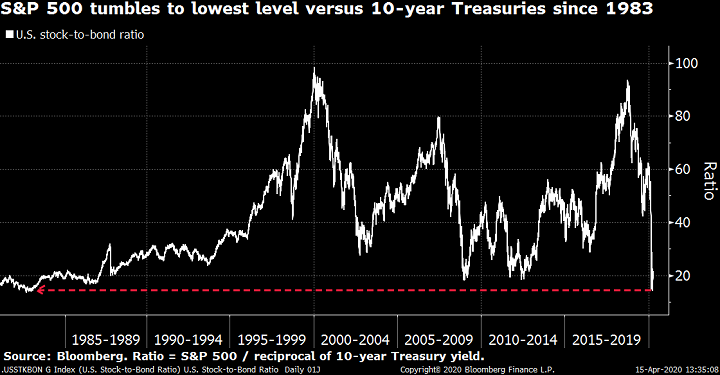
S&P 500 revisits '80s by tumbling relative to Treasuries

U.S. stocks have gone through their biggest bout of weakness relative to Treasury securities in decades, according to a barometer cited by Talley Leger, a senior investment strategist at Invesco US. The indicator is the ratio between the S&P 500 Index and the reciprocal of the 10-year Treasury’s yield, which he presented in an April report on market gauges. The ratio started this month by closing at its lowest level since 1983 after tumbling 85% from a high in October 2018. A rebound is needed for stocks to recover, Leger wrote.


Wednesday, March 4, 2020

Record-low Treasury yield gives S&P 500 utilities more appeal

Utility stocks have more to offer income-seeking investors now that the yield on 10-year Treasury notes has set a record low. The S&P 500 Utility Index’s dividend yield surpassed the Treasury yield by more than 200 basis points Tuesday, when the latter fell below 1% for the first time, according to data compiled by Bloomberg. The yield gap rose above the threshold Friday for the first time since June 2013, and then narrowed Monday as stocks rallied. Utility and 10-year yields diverged after coming within 8.5 basis points of each other in November 2018. Each basis point equals 0.01 percentage point.


Monday, May 14, 2018

S&P 500 loses yield advantage over 3-month T-bills

Investors looking for income have more incentive to cast aside U.S. stocks for Treasury bills than they have in the past decade. The S&P 500 Index closed last week with a dividend yield of 1.89 percent, or 1 basis point less than the bond-equivalent yield on three-month bills. Friday was the first day since February 2008 when the S&P 500 had a lower yield, based on payouts for the past 12 months. Each basis point amounts to 0.01 percentage point.

Wednesday, August 10, 2016

Looking for income? Consider S&P 500 stocks

“Investors ought to look at some stocks as sources of income,” strategists at Bank of America Corp.’s Merrill Lynch unit wrote Tuesday in a report. Sixty-four percent of stocks in the S&P 500 Index had dividend yields that exceeded the 10-year Treasury note’s yield at the end of July, according to data cited by the firm’s Research Investment Committee. Comparable figures from a decade ago were as low as 1 percent.

Tuesday, April 10, 2012

Stock-bond ‘disconnect’ favors U.S. equities

 “A significant disconnect” between stock valuations and bond yields in the U.S. has made equities relatively cheap, according to Binky Chadha, Deutsche Bank AG’s chief global strategist.
     

The chart shows the comparison he used to reach this conclusion. The projected price-earnings ratio for the Standard & Poor’s 500 Index, as compiled by Bloomberg, is depicted along with the yield on 10-year Treasury notes.

     Ten-year yields would have to rise about 120 basis points to track the estimated P/Es as they did during the first three quarters of 2011, Chadha wrote in an April 5 report. Each basis point amounts to 0.01 percentage point. The government security yielded 2.04 percent as of yesterday.

     The differential primarily reflects the Federal Reserve’s plan to keep its benchmark interest rate close to zero at least through late 2014, in his view.

     “The Fed’s outlook for unemployment and inflation is therefore key” in determining when the gap might close, Chadha wrote. Policy makers for the central bank are scheduled to meet on April 24-25.

     Stocks are a bargain with the S&P 500 at about 13 times analysts’ projected earnings for this year, the New York-based strategist wrote. He cited a December report in which he called the index fairly valued at 15.4 times future profit.