Showing posts with label SPY. Show all posts

Thursday, June 16, 2022

Market update: Federal Reserve hikes short-term rates by 0.75% (15 June 22)

S&P 500 after the Fed's 75-basis point rate hike yesterday, which was the largest move in 28 years.

Several central banks elsewhere also raising their key rates:  the Swiss National Bank surprised overnight with a 50-basis point rate hike (its first hike in 15 years), Brazil's central bank raised its key lending rate by 50 basis points, and the Bank of England increased its key lending rate by 25 basis points while projecting a 0.3% decline in Q2 GDP as a whole. 


Wednesday, May 4, 2022

Market update: Federal Reserve hikes short-term rates by 0.50% (4 May 2022)

The Federal Reserve increased short-term interest rates on Wednesday, as expected, raising the fed funds target range by 50 basis points to 0.75-1.00%, the biggest increase in 22 years.  The stock market surged and Treasury yields fell as Fed chief Jerome Powell signaled supersize rate hikes are off the table in June and July.


Fed chief Powell says it's crucial that inflation is brought down quickly. But Powell said he sees rate hikes of "50 basis points" on the table for the next couple of Fed meetings. He added that policymakers aren't actively considering 75 basis points. Markets had priced in a good chance of three-quarters of a point hikes at the June and July Fed meetings.

Fed chief Powell's less-hawkish-than-feared rate-hike forecast sent stocks sharply higher and Treasury yields lower.

Dow Jones Industrial Average -6.3% YTD
S&P 500 -9.8% YTD
Russell 2000 -13.2% YTD
Nasdaq Composite -17.1% YTD

 
 All 11 S&P 500 sectors closed higher with gains ranging from 1.1% (real estate) to 4.1% (energy). Ten sectors advanced more than 2.0%.


 ** The following day **
 

Friday, November 5, 2021

Broader Russell 2000 gains are seen as economic positive

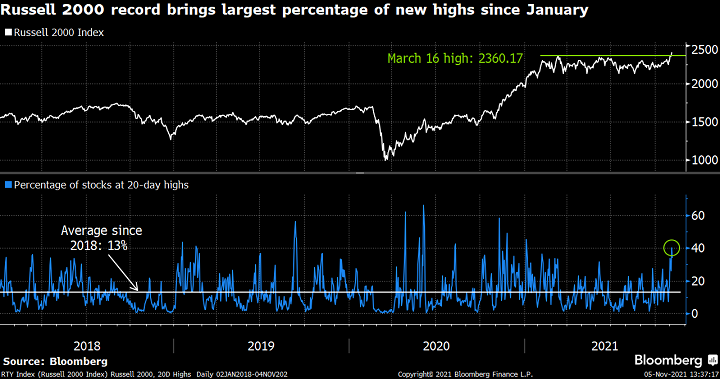
Smaller U.S. companies are sending a positive signal for the economy, according to Chris Verrone, head of technical and macro research at Strategas Research Partners LLC. He cited broadening gains within the Russell 2000 Index in a Twitter post Thursday. More than 40% of the Russell’s component stocks closed at 20-day highs Wednesday as the index set a record, according to data compiled by Bloomberg. The percentage was the largest since January and more than triple the average since 2018.


** 7 months later **

Wednesday, June 10, 2020

Market update: The Fed keeps interest rates unchanged (10 June 20)

The Federal Reserve kept the target range for the fed funds rate unchanged at 0.00-0.25%, and its dot plot signaled rates will remain near zero through at least 2022. 
The Fed's economic projections called for a 6.5% contraction in 2020 GDP, followed by 5.0% growth in 2021. Core PCE inflation is expected to remain below the Fed's 2.0% target through 2020. 


After the release of the policy directive, the S&P 500 erased prior losses and gained as much as 0.5%, but stocks quickly retraced those gains during Fed Chair Powell's press conference. Mr. Powell didn't say anything particularly new, reiterating the Fed's commitment to supporting the economy, but he did subtly urge Congress to do more. 

In the Treasury market, longer-dated maturities saw greater demand following the FOMC statement. The 2-yr yield declined three basis points to 0.17%, and the 10-yr yield declined eight basis points to 0.75%. The U.S. Dollar Index declined 0.3% to 96.02. WTI crude gained 1.6%, or $0.62, to $39.54/bbl.

Nasdaq Composite +11.7% YTD
S&P 500 -1.3% YTD
Dow Jones Industrial Average -5.4% YTD
Russell 2000 -12.1% YTD


Wednesday, March 18, 2020

Market update: trading halted for the 4th time in 8 days (18 March 2020)

At 1:12 ET, the Level 1 circuit breaker was triggered with a 7.0% decline in the S&P 500. Trading was halted for 15 minutes. This is the 4th time trading was halted in the past 8 days.

 A cross-market trading halt can be triggered at three circuit breaker thresholds that measure a decrease against the prior day's closing price of the S&P 500 Index -- 7% (Level 1), 13% (Level 2), and 20% (Level 3) (NYSE, NYSE American and NYSE Arca Rule 7.12).

YTD:
  • Nasdaq Composite: -22.1% 
  •  S&P 500: -25.8% 
  •  Dow Jones Industrial Average: -30.3% 
  •  Russell 2000: -40.6%


Friday, January 31, 2020

Market update (31 January 20)

The stock market sold off to end the week, and month, on growing concerns about the coronavirus and the negative effect it could have on economic growth.  

The coronavirus angst was exacerbated by increasing reports of worldwide cases; Delta Air Lines (DAL), United Airlines (UAL), and American Airlines (AAL) suspending U.S.-China flights; and the White House declaring a public health emergency in addition to announcing some travel restrictions. 

 
Fri, Jan 31, 20

Worried by the mounting death toll from the coronavirus and drastic efforts to contain it, investors dashed for the exits,

coronavirus-related stocks on Fri Jan 31, 20

S&P 500, 14 months

YTD
Nasdaq Composite +2.0% 
S&P 500 -0.2%  
Dow Jones Industrial Average -1.0%  
Russell 2000 -3.3%  

GSG commodity index, renko chart


The Economist, Bloomberg Businessweek covers

sold out masks at CVS

Latest coronavirus news:  
- Chinese authorities have reported more than 350 fatalities
- China has banned burials or funerals for virus victims
- There are over 14,000 confirmed cases worldwide
- Hong Kong, Japan, Singapore, UAE and the US have confirmed more infections
- The outbreak has reached more than two dozen countries and regions globally
- Several countries are halting flights to and from China
- WHO declared the virus was a public health emergency of international concern

Update Tue Feb 4, 20: China injects $57 billion into banks

Tuesday, January 7, 2020

S&P 500 valuation gauge challenges Internet-bubble highs

 U.S. stocks have “no room for error” after rising for more than a decade, according to Peter Boockvar, chief investment officer at Bleakley Advisory Group LLC. Boockvar cited the ratio between the S&P 500 Index’s enterprise value, reflecting debt and cash levels along with market value, and Ebitda -- earnings before interest, taxes, depreciation and amortization -- in an email Monday. The ratio spent multiple days above 14 last month for the first time since 2000, when an Internet-driven bubble in stocks burst, according to data compiled by Bloomberg. Tuesday’s reading was 14.1.

Friday, November 29, 2019

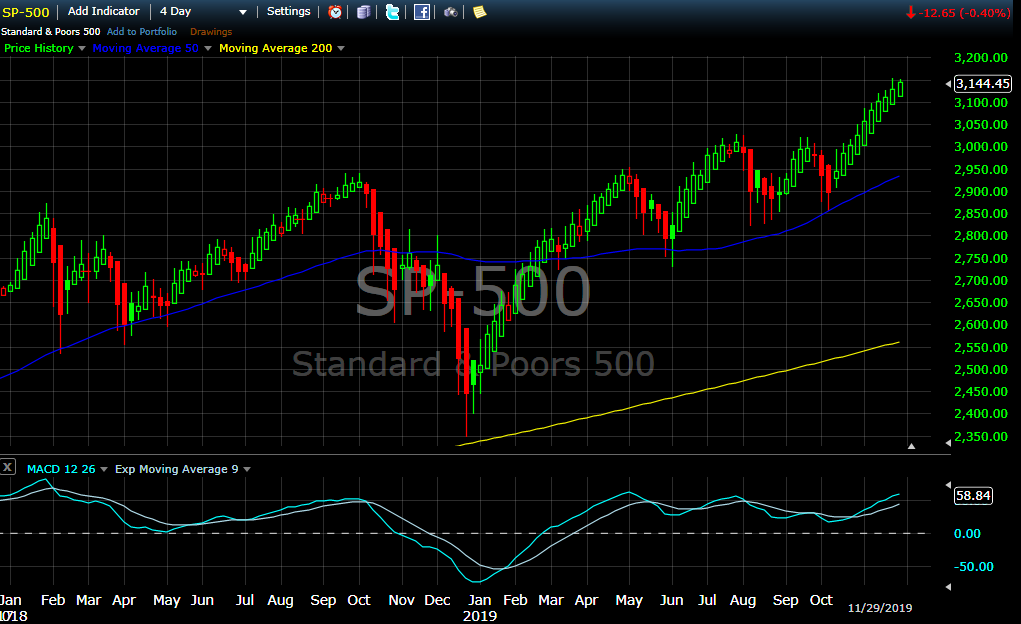
Market update (29 Nov 2019)

Nasdaq Composite +30.6% YTD
S&P 500 +25.3% YTD
Russell 2000 +20.5% YTD
Dow Jones Industrial Average +20.3% YTD

S&P 500 - 2 years

Wednesday, October 30, 2019

Market update: Federal Reserve cuts interest rates by 0.25% for the third time this year (30 Oct 2019)

3rd rate cut this year:  The Federal Reserve did exactly what was expected Wednesday by lowering its key policy interest rate one-quarter percentage point, to a range of 1.50%-1.75% and implying in the directive that it is unlikely to cut the fed funds rate again in December.
Fed Chair Powell, at his press conference, provided some dovish fodder with the suggestion that the Fed will need to see a significant move higher in inflation to raise interest rates to address such a development.
  • Nasdaq Composite +24.7% YTD
  • S&P 500 +21.1% YTD
  • Russell 2000 +17.0% YTD
  • Dow Jones Industrial Average +16.1% YTD


Wednesday, September 18, 2019

Market update: Federal Reserve cuts interest rates by 0.25% for the second time this year (18 September 2019)

FOMC Decision: Fed cuts its benchmark overnight lending rate 25 bps to 1.75-2.00% as widely expected
There was a 7-3 vote to cut the target range for the fed funds rate by 25 bps to 1.75-2.00%. Boston Fed President Rosengren and Kansas City Fed President George dissented on the belief the target range should be left unchanged at 2.00-2.25%. St. Louis Fed President Bullard dissented on the belief the target range should be cut by 50 basis points.
  • Nasdaq Composite +23.2% YTD
  • S&P 500 +19.9% YTD
  • Dow Jones Industrial Average +16.4% YTD
  • Russell 2000 +16.3% YTD


The FOMC voted 7-3 to cut the target range for the fed funds rate by 25 basis points to 1.75-2.00%, as expected. Price action leading up to the decision was muted and volatility quickly ensued after the policy directive. Buying conviction, however, was largely absent before and immediately after the decision as the market extended losses heading into Fed Chair Powell's press conference.

Key takeaways from the Fed's policy decision included:

(1) Voting members remained divided: St. Louis Fed President Bullard preferred a 50-basis points cut, while Boston Fed President Rosengren and Kansas City Fed President George preferred no change in the fed funds rate; (2) the median Fed member is suggesting there will be no more rate cuts in 2019 and 2020; and (3) the interest paid on excess reserve balances was lowered to 1.80% from 2.10% -- which could provide some stability in the repo market after the New York Fed injected more liquidity today.  

Selling pressure soon abated and stocks climbed to session highs, with the S&P 500 financials sector (+0.4%) providing influential leadership, as the Fed Chair Powell wrapped up his press conference. The utilities sector (+0.5%) outperformed, while the energy sector (-0.4%) underperformed as oil prices ($58.07/bbl, -1.30, -2.2%) continued to pull back. 

Mr. Powell said the Fed does not see a recession, is not interested in negative rates, and the repo issue has no implications for the economy or monetary policy. FedEx (FDX), meanwhile, provided a pessimistic view on the global economy. The company cut its FY20 EPS guidance due to a weakening global environment, driven by trade tensions and policy uncertainty.


President Donald Trump, who has been bashing the Fed on Twitter and demanding a larger cut, was predictably fast on his fingers.

President Trump, who has called Fed policymakers “boneheads” for not cutting rates enough, tore into Wednesday’s decision, saying Chairman Jay Powell and his colleagues have “no ‘guts.’” Trump says the Fed is risking U.S. competitiveness by keeping rates substantially higher than most of the rest of the developed world.

But Powell said he does not believe the Fed will ever resort to negative rates, instead relying on asset purchases and forward guidance, as it did following the 2008 financial crisis. For now, though, Powell foresees continued moderate growth for the U.S. economy.

Tuesday, March 19, 2019

Market update: key market catalysts (19 March 2019)

SPY daily and monthly

$SPX last 5 sessions

1.  Bank of America/Merrill Lynch fund manager survey
  • Latest survey showed allocation to equities is at its lowest since September 2016.  Implies many fund managers have missed/trailed the 2019 rally effort and will need to play catch up, providing more fuel to keep the rally going.
2.  Green shoots of economic optimism
  • Economic sentiment in Germany was better than expected in March and employment trends in the UK were also better than expected, highlighted by the lowest unemployment rate (3.9%) since 1975, according to Reuters.
  • The reassuring data helped stoke the narrative that the global economy may be bottoming (or has bottomed), which has driven buying interest in cyclical sectors.
3.  Ongoing leadership from the semiconductor stocks
  • This industry group is regarded as having leading indicator status, so it resonates as a positive marker that the Philadelphia Semiconductor Index is up 21.9% year-to-date, including today's 1.4% gain.
  • Strength in the semis has been a key source of support for the information technology sector (+0.3%), which is the market's most heavily-weighted sector.
4.  Frontrunning the Fed
  • The stock market knows the Fed is on its side at the moment.  On Wednesday, it expects the FOMC to reinforce that position by holding the fed funds rate steady and reiterating a patient mindset. 
  • This expectation, and the speculation that the dot plot will show a reduced rate-hike projection for 2019 (the median estimate in December called for two rate hikes), and that the Fed could announce a plan regarding the timing for ending its balance sheet runoff, have helped keep selling interest in check.

President Trump hosts Brazil’s new leader

Today, President Trump welcomed the recently elected President of Brazil, Jair Bolsonaro, to the White House.

President Bolsonaro’s election marked a historic opportunity for the United States and Brazil—the two largest democracies in the Western Hemisphere—to build a new partnership focused on increased prosperity, strong security, and national sovereignty.

Perhaps most important, Brazil is a crucial ally in President Trump’s stand against the corrupt, socialist Maduro dictatorship in Venezuela. President Bolsonaro reiterated that Brazil stands with Venezuelan Interim President Juan Guaido, as well as with the democratically elected National Assembly and the Venezuelan people in their fight against tyranny.

“The twilight hour of socialism has arrived in our hemisphere,” President Trump said from the Rose Garden this afternoon. “And hopefully, by the way, it’s also arrived—that twilight hour—in our great country.”

“I have always admired the United States of America,” President Bolsonaro added. “And this sense of admiration has just increased after you took office.”

President Trump said he will designate Brazil as a major non-NATO ally during the visit of Brazil's President Jair Bolsonaro to the White House. Argentina is the only other South American country with that designation.


President Jair Bolsonaro, left, presents Donald Trump with a Brazil national football jersey after the US leader gave him a US soccer team shirt

Wednesday, September 26, 2018

Market update: Federal Reserve hikes short-term rates by 0.25% (26 September 2018)

The Federal Reserve increased short-term interest rates on Wednesday, as expected, raising the fed funds target range by 25 basis points to 2.00-2.25%.
  • Fed hikes interest rates, raises its economic outlook and drops 'accommodative' language
  • Fed's Powell: Lack of 'accomodative' language a sign policy inline with expectations


Stocks were up modestly ahead of the release of the Fed's decision, which crossed the wires at 2:00 PM ET, and extended gains after the central bank removed the word 'accommodative' from its policy statement. However, that initial move was reversed, and then some, following a post-decision press conference from Fed Chairman Jerome Powell, during which he said the language change didn't signal a change in the Fed's path for rate hikes.

The S&P 500 was up as much as 0.5% on Wednesday but fell sharply in the final minutes of the session to finish with a loss of 0.3%. The tech-heavy Nasdaq Composite ended lower by 0.2%, the blue-chip Dow Jones Industrial Average finished lower by 0.4%, and the small-cap Russell 2000 lost 1.0%.

As for rate-hike projections, the Fed still appears to be on track to raise rates another 25 basis points in December, with the CME FedWatch Tool putting the chances at 79.2%. Beyond 2018, the Fed's dot plot showed expectations for three rate hikes in 2019 (unchanged from June) and one in 2020 (also unchanged from June).

U.S. Treasury yields fell following the Fed's policy announcement, although the 2-yr yield managed to close unchanged at 2.83%. The yield on the benchmark 10-yr Treasury note dropped four basis points to 3.06%. In currencies, the U.S. Dollar Index finished +0.2% at 93.90, but was volatile after the release.

The drop in Treasury yields weighed on the rate-sensitive financial sector, which finished at the bottom of the sector standings with a loss of 1.3%. The energy sector (-1.0%) was another notable laggard, dropping in tandem with the price of crude oil; WTI crude futures finished -1.0% at $71.58/bbl.

Monday, August 27, 2018

Market update : The market busts out of 7-month long correction (27 August 2018)

Wall Street extended Friday's push into record territory on Monday, with the S&P 500 registering its second straight record close.  President Donald Trump said the U.S. has reached an agreement with Mexico to enter into a new trade deal, calling it the U.S.-Mexico trade pact.  With a U.S.-Mexico deal in place, Canada will now come to the negotiating table as the three nations look to fully replace their three-way NAFTA deal.
  • S&P 500 today's close: 2896;  Jan 26 close:   2872
  • Nasdaq Composite +16.1% YTD
  • Russell 2000 +12.6% YTD
  • S&P 500 +8.4% YTD
  • Dow Jones Industrial Average +5.4% YTD
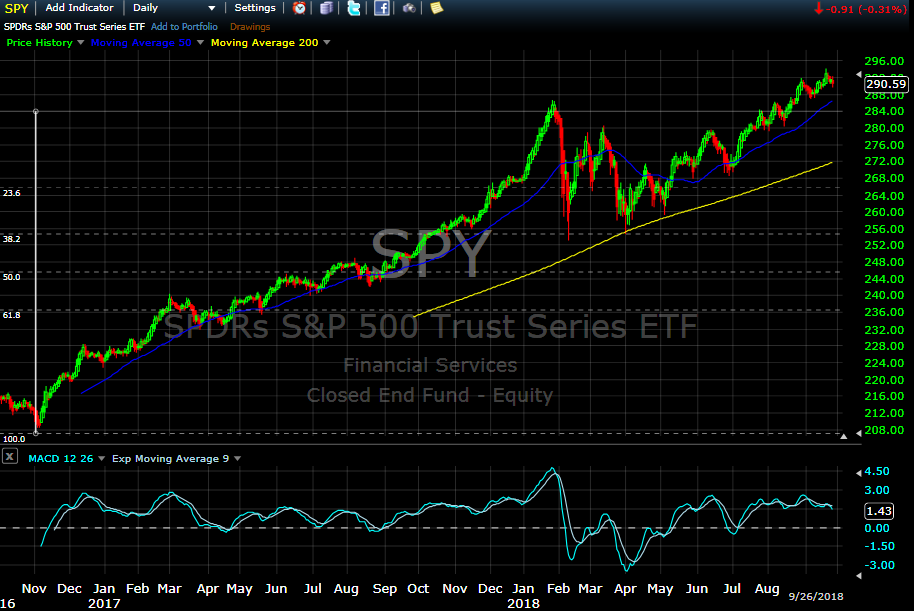
$SPY since the 2016 Election (22 months) with Fibonacci retracement.

A table showing the performance of various asset classes since the prior S&P 500 high on 1/26.  We also show YTD and QTD performance.  As you see, US equities have been dramatically outperforming international stocks.

Friday, August 10, 2018

Market update : Turkish Lira Rattles Investors Around the Globe (10 August 2018)

The S&P 500 started the week on a positive note, extending last week's winning streak and coming within 0.5% of its January 26 record high (26-Jan-18 close 2872) . However, the index struggled in the back half of the week, especially on Friday amid a sharp drop in the Turkish lira, eventually settling with a weekly loss of 0.3% -- its first weekly loss since late June.
  • The Turkish lira tumbled to a record low against the dollar largely over worries about President Tayyip Erdogan’s influence over the economy, his repeated calls for lower interest rates in the face of high inflation, and a deepening rift with the United States. President Trump doubled tariffs on aluminum and steel imports from Turkey, deepening the currency's losses and raising concerns that the crisis could weigh on other economies. 
  • Turkey is now facing the most serious financial crisis since Mr Erdogan took office 15 years ago.  The decline in the Turkish lira and rising borrowing costs cause a big headache for many Turkish companies, as they have borrowed in foreign currency despite receiving revenues in local currency.
  • In a tumultuous day on the financial markets, the lira tumbled by 14.3% against the dollar to TL6.47 from the previous New York close. At one stage it fell as much as 18.5%. The currency has lost more than 40% of its value so far this year. The lira’s implosion rippled across other emerging market currencies, pulling the likes of the South African rand, the Argentine peso and the Russian rouble lower by between 1.5 and 3.5%.

$SPY since the 2016 Election (21 months) with Fibonacci retracement. 


$SPX - 6 months


President Trump added to the pressure when he made a shock announcement on Twitter. “I have just authorised a doubling of Tariffs on Steel and Aluminum with respect to Turkey as their currency, the Turkish Lira, slides rapidly downward against our very strong Dollar!” he tweeted. “Aluminum will now be 20% and Steel 50%. Our relations with Turkey are not good at this time!”

Turkish lira

  • Mr Erdogan urged Turks to stand firm and defend their currency. “If there is anyone who has dollars, euros or gold under the pillow, he should go and convert this at the bank,” Mr Erdogan said.
  • He also held talks by telephone with Russian president Vladimir Putin to discuss economic and commercial ties.


  • Here's how Turkey's currency has fallen against the dollar in the past 10 years – and some reasons for the fall. 

    Other currencies - largest ETFs


    Fri 8/10/18 perf, weekly charts (daily charts, monthly charts)

    Country ETFs - largest drops


    Fri 8/10/18 perf, weekly charts (daily charts, monthly charts)

    Euro banks
    European banks who have lent to Turkey are feeling the heat. Spanish banks have the biggest total exposure, with more than 30% of total foreign claims on Turkey--about double what it was in early 2013. French banks are next at about 15%, with UK banks accounting for 7% of total foreign claims.


    • The Financial Times reported that the European Central Bank is concerned about eurozone banks' exposure to Turkey because of the tanking lira. The ECB declined to comment.
    • Data from the Bank for International Settlements show eurozone banks have loans worth over $150 billion in Turkey. Spanish, French and Italian banks are the most exposed.
    • Shares in some of Europe's biggest banks were hard hit on Friday. Italy's UniCredit (UNCFF) shed 5.6% and Spanish lender BBVA (BFR) dropped 5.5%. France's BNP Paribas (BNPQF) was off by 4.3% and Deutsche Bank (DB) fell 5.3%.


    The  Evangelical preacher  Andrew Brunson was  released from prison in July 2018.  The Trump administration had thought that it had secured a deal to release the pastor, but Turkey instead put him under house arrest, which angered Washington.


    Recep Tayyip Erdogan, president and former prime minister of Turkey.

    Under Erdogan and his ruling Justice and Development Party (AKP), Turkey has lifted restrictions on public expression of religion, including ending the ban on women wearing Islamic-style headscarves.
    • Born: February 26, 1954;  Istanbul, Turkey
    • 2003-2014 - Serves as prime minister.
    • August 10, 2014 - Erdogan is elected president during the first-ever direct elections.
    • July 15-16, 2016 - During an attempted coup by a faction of the military, at least 161 people are killed and 1,140 wounded. Erdogan addresses the nation via FaceTime and urges people to take to the streets to stand up to the military faction behind the uprising. He blames the coup attempt on cleric and rival Fethullah Gulen, who lives in self-imposed exile in Pennsylvania.
    • June 24, 2018 - Is re-elected president.
    • The Turkish economy has expanded rapidly this year compared with 2017. But its growth in recent years has been fueled by construction financed largely by foreign investors.
    • The European Central Bank expressed concern about the country when President Recep Tayyip Erdogan was re-elected in a snap vote in June and whose growing power has raised questions about the independence of the country’s central bank.


    U.S. - Turkey grievances (military and political)
    • An evangelical preacher, Andrew Brunson,  is one of about 20 Americans, including a NASA scientist and chemistry professor from Pennsylvania, who have been swept up in Mr. Erdogan’s crackdown since the failed coup two years ago. 
    • Mr. Brunson who was applying for Turkish permanent residency, having lived there 23 years, was imprisoned on October 7, 2016, accused of being a member of the Gülen movement, which the Turkish government considers to be a terrorist organization.  On July 26, 2018, US Vice President Pence called on Turkish President Recep Tayyip Erdogan to release Brunson or face significant sanctions.  President Trump has raised the pressure over the issue because he wants to appeal to Evangelical voters ahead of November midterm elections.
    • Turkey is a major player in the Middle East that’s engaged in war.  American support for Kurds and backing of Kurdish terrorists in Syria, the number one enemy of Turks, has galvanized Turks against the US, now broadly seen as Turkey's enemy. America's gungho pro-Saudi/pro-Israeli pivot & participation in the ongoing genocide in Yemen isn't helping; Turkey sees itself as the moderate leader of the Islamic world and Saudi Arabia as a dangerous rival. 
    • Trump's abandonment of the Iran nuclear deal is another sore point; nearly half of Turkey's oil imports come from Iran, and the re-imposition of sanctions against Iran hurts Turkey's economy.
    • American relations with Turkey were further aggravated by Mr. Erdogan’s embrace of Russia, particularly when Turkey signed a deal in  September 2017 to purchase Russia’s S-400 surface-to-air-missile system. The deal would mean Russian military technicians operating in NATO’s backyard. What especially irked the United States was that Turkey had also been in the midst of purchasing American F-35 joint strike fighters. Congress has since moved to block deliveries unless Turkey cancels the Russia deal. 
    • Mr. Erdogan says the 2016 coup was orchestrated from the United States, and specifically by a Muslim cleric, Fethullah Gulen, from his self-imposed exile in Pennsylvania. Turkish authorities have demanded that he be extradited, something American officials have dismissed, and the detained Americans are widely seen as bargaining chips.