Showing posts with label oil prices. Show all posts

Wednesday, March 23, 2022

Russian Urals crude oil

The Russian Urals grade of crude oil, relative to Brent (the international benchmark), has dropped by nearly $30 since the invasion of Ukraine, only exacerbated by the onset of sanctions. Although energy payments haven't been sanctioned yet, given the West's dependence on Russian commodities, it hasn't stopped buyers from pulling out and seeking alternatives.

Urals-Brent price difference

For Russia, this means it is making less per barrel of oil it exports. But for other countries, it's a bargain. India, the third largest oil consuming nation, is an example. And now India's central bank is in talks with Moscow on a rupee-ruble trade agreement. Should other countries who remain tied to Russian exports do the same, this spread will be worth watching. 

Vladimir Putin and Narendra Modi in New Delhi in December 2021.

Wednesday, March 16, 2022

Brent crude's open interest lowest since 2015

The oil market has been extremely volatile as it faces a liquidity crunch and geopolitical tensions on multiple fronts. For investors, higher prices isn't always a good thing. Big swings mean fewer people wanting to trade it. That's best exemplified in this chart, which shows Brent crude's open interest is at its lowest since 2015.
 
Brent crude's open interest is at its lowest since 2015 

Arguably the more notable trend is that there's been a decline in open interest throughout 2021 as oil prices rose. There are two reasons for that. The first is higher margins, otherwise known as the cost of trading oil. Given that cost is linked to volatility, it's effectively been getting more expensive to hold the same number of contracts.

The second reason for the decline is dropping inventories. Traders that hold supply in oil tankers hedge using futures contracts. So when those tanker-held inventories fall, so does open interest. All in all, it means fewer people want to trade oil. Add on bigger swings and spreads, and it creates a very illiquid trading environment.

Thursday, January 20, 2022

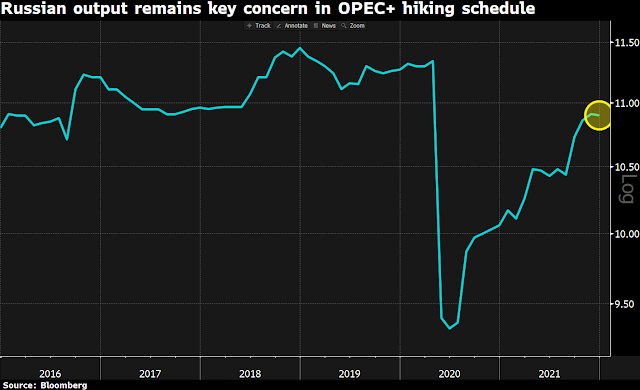
Russia's oil production still below pre-Covid level

Russia is the second largest global oil producer after Saudi Arabia. Russia's oil production still hasn't recovered to pre-pandemic levels after its steep drop in 2020. It's no secret that demand for oil, as part of the global recovery, is strong. So strong that ramping up production is proving difficult, even for OPEC+'s biggest producers.

Russia's combined crude and condensate production

Within the OPEC+ cartel, only Saudi Arabia and the UAE have the capacity to ramp up production to pre-Covid levels. Whereas, Russia is expected to only be able to meet half of its expected output over the next six months. For investors, economists and even the Biden administration, that's a problem. It means less relative supply in the face of ongoing demand. In other words, higher oil prices are inevitable, which could further eat into disposable consumer income and ultimately company earnings. 

Friday, May 1, 2020

S&P 500 is seen needing commodity help to solidify rally

 U.S. stocks can use some help from commodities for their six-week rally to be “on solid ground,” according to Barrry B. Bannister, Stifel Nicolaus & Co.’s head of institutional equity strategy. Bannister compared the S&P 500 Index with the ratio between Brent crude oil and gold, which he cited as an inflation gauge, in a report Wednesday.
 

The ratio fell eight weeks ago to its lowest level since Brent futures began trading in 1988 and then dropped as much as 57% more through Thursday, according to data compiled by Bloomberg. Rebounds in the oil-gold ratio led to S&P 500 lows in 2002, 2009 and 2016, Bannister wrote.

Wednesday, April 11, 2012

Record oil-gas ratio may spur truck-fuel shift

Natural gas is the truck fuel of the future because crude oil and related products have become
increasingly costly in relative terms, according to Alexander E. Potter, an analyst at Piper Jaffray Cos.
     

The above chart tracks the price ratio between a barrel of oil and a million British thermal units of gas on the New York Mercantile Exchange. The ratio rose above 50 yesterday for the first time since gas futures began trading on the Nymex in April 1990.

     Average U.S. pump prices for the diesel fuel used in trucks have risen about three times as much as crude since 2008, when the chart begins, according to data compiled by the American Automobile Association.
     “Natural gas is replacing diesel as the preferred truck fuel,” Potter, based in Minneapolis, wrote in a report two days ago. He estimated that trucks running on compressed or liquefied natural gas may rise to 20 percent of sales in five years. They accounted for only 0.9 percent of North American sales in 2010, according to Frost & Sullivan, a consulting firm.

     Trucking companies can save as much as $32,000 a year by fueling their vehicles with gas rather than diesel, the report said. The savings approach the $35,000 cost of converting to a gas-powered truck.

     “Diesel will one day be considered obsolete when it comes to fueling truck fleets,” Potter wrote. He recommended buying shares of Westport Innovations Inc., the maker of a gas engine suitable for heavy trucks, to profit from the shift.

Wednesday, March 21, 2012

Copper-oil ratio signals drop in U.S. stocks

Commodity prices are signaling this year’s rally in U.S. stocks will fade, according to Gina Martin
Adams, a Wells Fargo & Co. strategist.
     
The ratio between copper and crude-oil futures vs the Standard & Poor’s 500 Index.
     
“When copper is accelerating faster than oil prices, stocks tend to do particularly well,” Martin Adams wrote two days ago in a report with a similar chart. “Much the opposite has been the case recently.”
     
From this year’s peak on Feb. 6, the ratio fell 9 percent through yesterday. The S&P 500 advanced 4.6 percent during the same period.

     “The direction of copper is historically one of the best leading indicators” of global economic growth, the New York-based strategist wrote. This contributes to the copper-to-oil ratio’s usefulness as a stock-market gauge, the report said.

     Price moves affecting the ratio can make or break earnings estimates, Martin Adams added. Her projection of $102 a share in S&P 500 profit this year assumes commodity costs will be little changed. Copper rose 11 percent for the year through yesterday, and oil rose 6.9 percent.
 
 
*** Update 10 years later ***
 
SPY monthly