Showing posts with label chip stocks. Show all posts

Thursday, June 16, 2022

Semiconductor (chip) stocks -- Acquisitions & Rebrandings


  • Tessera Technologies (TSRA) transformed into a massive entertainment and IP-licensing conglomerate through a series of acquisitions and corporate restructurings,  eventually splitting into two separate publicly traded entities: Adeia Inc. and Xperi Inc.   2022: The conglomerate officially separated its businesses. The product business became the new Xperi Inc. (NYSE: XPER), while the original IP licensing business was renamed Adeia Inc. (NASDAQ: ADEA)
  • Resonant (NASDAQ: RESN) to be acquired by a subsidiary of Japan-based Murata Manufacturing Co. Ltd. (MRAAY) for $4.50/sh or approx. $295.7 million. (Feb 2022)
  • Xilinx (XLNX) was acquired by AMD for $60 billion (Oct 2020).
  • Maxim Integrated (MXIM) acquired by rival chipmaker Analog Devices (ADI) for $20.91 billion. (13 July 2020)
  • Cypress Semiconductor (CY) was acquired by the German semiconductor company Infineon Technologies (IFNNY) in April 2020 in a landmark $10 billion.
  • Cavium (CAVM ) was acquired by Marvell Technology Group in July 2018 for approximately $6 billion in cash and stock.
  • ARM Holdings (ARMH); United Kingdom-based; acquired by SoftBank for $32 billion (7/16); Apple supplier; maker of chips used in smartphones. A dominant player in the smartphone tablet market. It licenses its chip technology to some tech heavyweights like Apple, Samsung and Qualcomm (Nasdaq:QCOM), among others, that also pay royalties.
  • Linear Technology (LLTC) acquired by Analog Devices (ADI). (July 2016)
  • Atmel Corporation (ATML) was officially acquired by Microchip Technology (MCHP) in July 2016 for $3.56 billion.
  • PMC-Sierra (Nasdaq:PMCS) was acquired by Microsemi Corporation (Nasdaq:MSCC) in January 2016.  Microsemi Corporation (Nasdaq:MSCC) was acquired by Microchip Technology (MSCC) for over US$10 billion. (Feb 2018).
  • Freescale Semiconductor (FSL) was acquired by NXP Semiconductors (NXPI) for about $16.7 billion. (7 Dec 2015)
  • Altera Corp. (NASDAQ: ALTR) acquired by Intel (NASDAQ: INTC) for $17 billion. (June 2015)
  • Broadcom Corp. (NASDAQ: BRCM); California-based; top supplier to both Samsung and Apple; acquired by Avago Technologies (NASDAQ: AVGO) for $37 billion. (June 2015) 
©Artremis (EAS 2/12/22)

Sunday, February 13, 2022

Semiconductor (chip) stocks

Semiconductors, also known as semis, or chips,  can be found in thousands of products such as computers, smartphones, appliances, gaming hardware, and medical equipment.
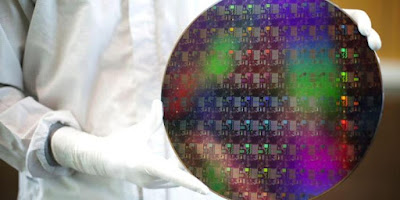
  • A semiconductor chip is an electric circuit with many components such as transistors and wiring formed on a semiconductor wafer. An electronic device comprising numerous of these components is called integrated circuit (IC). Semiconductors can be classified into a small number of categories including memory chips, microprocessors, graphics processing units (GPUs), and integrated chips.
  • Never has the sector been more competitive, with more than 750 companies vying globally to build the insides of the next hot device or power future mega computers.
ETF  (avg daily vol)  
SMH  The VanEck Vectors Semiconductor ETF  (5.9M)
(by market cap)                
Ticker       Company name Mkt Cap▼
  1. NVDA  NVIDIA Corp. 5.02T; Santa Clara, California
  2. TSM     Taiwan Semiconductor Manufacturing   2.21T; Taiwan
  3. AVGO Avago Technologies 1.79T; Palo Alto, California;  Apple supplier
  4. MU   Micron Technology  1.15T; Boise, Idaho
  5. AMD   Advanced Micro Devices  827.19B; Santa Clara, California
  6. ASML ASML Holding  719.90B; Netherlands
  7. INTC      Intel Corp.  588.29B; California-based; PC market, strong growth in digital color graphics.
  8. AMAT   Applied Materials   470.75B; USA
  9. LRCX   Lam Research   467.94B; USA
  10. ARM Arm Holdings Plc ADR; 421.71B; United Kingdom
  11. KLAC KLA Corp 311.85B; USA
  12. TXN     Texas Instruments    278.22B; Texas
  13. MRVL   Marvell Technology  243.78B; Wilmington, Delaware
  14. QCOM   QUALCOMM  225.63B; San Diego, California
  15. ADI   Analog Devices  202.63B; Wilmington, Massachusetts
  16. ASX   ASE Technology  80.82B; Taiwan
  17. NXPI       NXP Semiconductors N.V.     76.47B: Netherlands; the world’s number one supplier for small-signal discretes; will supply the near field communications (NFC) module and secure element NFC booster chip. NFC is a set of standards for smartphones and other devices like the Apple Watch to establish radio communication with each other by touching them together or bringing them into close proximity, usually no more than a few centimeters.
  18. MPWR    Monolithic Power Systems  73.63B:  California-based; designs high-performance, energy-efficient analog semiconductors for use in cloud computing, telecom, automotive and other industries.
  19. STM STMicroelectronics NV 66.26B; Switzerland
  20. ALAB Astera Labs 62.00B; San Jose, California
  21. UMC  United Microelectronics Corporation  54.38B; Taiwan
  22. MCHP Microchip Technology 51.84B; Chandler, Arizona
  23. CBRS Cerebras Systems 46.61B; Sunnyvale, California
  24. ON ON Semiconductor Corp. 46.34B; automotive chip specialist
  25. CRDO Credo Technology Group 44.12B; Cayman Islands
  26. GFS GlobalFoundries 43.83B; Malta, New York
  27. TSEM Tower Semiconductor 30.01B; Israel
  28. MTSI MACOM Technology Solutions 28.10B; USA
  29. ENTG Entegris 23.99B; USA
  30. LSCC Lattice Semiconductor 19.66B; USA
  31. SITM SiTime 18.08B; Santa Clara, California
  32. SMTC Semtech Corp 15.05B; USA
  33. RMBS Rambus 14.33B; USA
  34. SWKS    Skyworks Solutions   10.74B : Irvine, California; The company makes radio frequency chips used in Apple's iPhone, Samsung's Galaxy as well as many other wireless devices. 
  35. ALGM Allegro Microsystems 9.92B USA
  36. SIMO Silicon Motion Technology 9.49B Hong Kong
  37. QRVO    Qorvo 8.50B: North Carolina; radio frequency (RF) solutions for mobile, infrastructure, and aerospace and defense applications.
  38. VSH Vishay Intertechnology 8.22B USA
  39. CRUS     Cirrus Logic   8.11B ; Austin, Texas; Apple supplier; makes audio integrated circuits and microphones used in smartphones.
  40. MXL MaxLinear 7.56B USA
  41. SLAB Silicon Laboratories 7.24B USA
  42. SYNA Synaptics 5.21B USA
  43. NVTS Navitas Semiconductor 5.16B USA
  44. DIOD Diodes 5.03B USA
  45. POWI Power Integrations 4.42B USA
  46. PI Impinj  3.95B USA
  47. LASR nLIGHT  3.74B USA
  48. HIMX Himax Technologies  2.93B; Taiwan
  49. POET POET Technologies 2.18B; Canada
  50. WOLF   Wolfspeed  2.18B; formerly known as Cree; Durham, North Carolina
  51. IMOS Chipmos Technologies 2.05B; Taiwan
  52. AIP Arteris  1.92B; USA
  53. SKYT SkyWater Technology  1.78B; USA
  54. AMBQ Ambiq Micro  1.75B; USA
  55. AOSL Alpha & Omega Semiconductor   1.35B; USA
  56. CEVA Ceva   1.28B; USA
  57. INDI Indie Semiconductor   891.73M; USA
  58. LAES SEALSQ   706.94M; Switzerland
  59. MRAM Everspin Technologies   613.39M; USA
  60. NVEC NVE Corp   522.22M; USA
  61. ALMU Aeluma  432.37M; USA
  62. QUIK Quicklogic  376.89M; USA
  63. GSIT GSI Technology  288.76M; USA
  64. VLN Valens Semiconductor  247.44M; Israel
  65. GCTS GCT Semiconductor Holding  219.33M; USA
  66. MX MagnaChip Semiconductor  200.42M; South Korea
  67. IPWR Ideal Power  91.25M; USA
  68. WKEY WISeKey International  61.26M; Switzerland
  69. SQNS Sequans Communications S.A ADR France 48.74M
  70. NA Nano Labs   46.88M; China
  71. PXLW Pixelworks  40.72M; USA
  72. MOBX Mobix Labs  28.22M; USA
  73. ICG Intchains Group   20.97M; China
  74. LEDS Semileds   15.28M; Taiwan
  75. PRSO Peraso  13.05M; USA


  • Nova Measuring Instrument (NVMI)
  • Cascade Microtech (CSCD)
  • Cabot Microelectronics (CCMP)
  • Advanced Energy (AEIS)
  • PDF Solutions (PDFS)
  • Kulicke & Soffa Industries (KLIC)
  • MKS Instruments (MKSI)

charts - avg vol (3 months):  (day's change) (change from open) (by vol)


©Artremis (EAS 6/12/26)

Wednesday, January 12, 2022

Supply problems: semiconductors vs. retail

This chart compares the two sectors that have arguably been the most affected by supply chain issues: chipmakers and retail.

The Philadelphia Semiconductor Index vs the S&P 500 Retailing Index (logarithmic scale)

Chipmakers are dealing with rising commodity costs, and lagging lead times (the amount of time between when a semiconductor is ordered versus when it gets delivered.) Retailers, on the other hand, have to face higher margin costs and increasing wages. While stimulus, and therefore strong spending, has been offsetting those issues, government assistance will fade and the supply chain issues are likely to persist. That leaves retailers at a disadvantage. Chipmakers though, have a better growth case -- being used for everything from electric vehicles to the data centers that will one day power the metaverse. Add on longer-term plans to increase domestic production capacity, and it explains the outperformance.

Thursday, January 14, 2021

TSMC's market value surges beyond Intel, Nvidia combined

Taiwan Semiconductor Manufacturing Corp. has left its biggest Silicon Valley-based rivals far behind by one indicator: market value. The world’s largest contract producer of chips was valued at $661.5 billion at Thursday’s U.S. close, according to data compiled by Bloomberg. TSMC surpassed the total value of the two largest U.S. chip companies, Intel Corp. and Nvidia Inc., by $89.8 billion after disclosing plans for a surge in capital spending this year. TSMC exceeded their combined value for the first time only 5 1/2 weeks earlier, on Dec. 7.


Friday, May 31, 2019

Tech stocks diverge as U.S.-China trade dispute plays out: software vs. semiconductors

Technology stocks are increasingly diverging from each other as a trade war between the U.S. and China drags on, according to Michael Shaoul, Marketfield Asset Management LLC’s chief executive officer. Shaoul compared software developers with chipmakers, which he called “a trade proxy,” in a report Thursday. He cited the ratio between the S&P 500 Software and Philadelphia Semiconductor indexes. The gauge closed Tuesday at its highest level since a bull market in U.S. stocks began in March 2009, according to data compiled by Bloomberg. The peak followed a 22% surge in less than six weeks.

Thursday, April 25, 2019

Chip stocks rebuild strength as ratio nears 18-year high

Semiconductor stocks are showing the kind of strength they have lacked ever since the Internet-driven bull market of the 1990s collapsed. The ratio between the Philadelphia Semiconductor and S&P 500 indexes jumped 26 percent from a low in November through Wednesday, according to data compiled by Bloomberg. Another 1 percent advance would lift the ratio to its highest level since March 2001. Chipmakers are poised to rise as first-quarter results pave the way for higher earnings estimates, Mark Lipacis, an analyst at Jefferies LLC, wrote Tuesday in a report.

Wednesday, November 22, 2017

Semiconductor stocks reach March 2000 record

The Philadelphia Semiconductor Index took nine years and a day to rise from a multiyear low to its first record since March 2000, when an Internet-driven bull market peaked. The ascent in the industry gauge, known by its ticker symbol SOX, was more than six times longer than the one that produced the earlier record. Here’s another difference: Nvidia Corp., which wasn’t even publicly traded when the previous surge began in October 1998, led the current advance by soaring more than 36-fold.

Thursday, December 4, 2014

Copper loses to chips as stock indicator

The commodity that’s said to have a Ph.D. in economics because of its value as a growth indicator isn’t much of a stock-market barometer, according to Andrew Thrasher, an analyst at Financial Enhancement Group.

“Dr. Copper in my opinion has been replaced by technology, specifically semiconductors,” Thrasher wrote in a blog posting yesterday. “The market seems to be much more focused on the happenings of Silicon Valley than Milwaukee or Detroit.”

 S&P 500 Index, the Philadelphia Semiconductor Index and the price of copper in New York since March 2009, when stocks began their current bull market.

Copper futures set a record in February 2011 and tumbled 37 percent through yesterday, when the price for March delivery settled at $2.9145 a pound on the Comex. At the same time, the Philadelphia index of 30 chip producers rose 51 percent. The gain was in line with the S&P 500’s advance of 56 percent.

The semiconductor-stock gauge peaked in 2011 about two months before the S&P 500 began a 19 percent drop, the bull market’s biggest retreat, as Thrasher wrote in the posting.
“Ever since then, we’ve gotten confirmation” of the S&P 500’s highs from chip shares, he wrote. The Indianapolis-based analyst added: “It seems copper has been expelled while the semiconductors step to the front of the class.”