Showing posts with label market outlook. Show all posts

Wednesday, December 28, 2022

Friday, December 23, 2022

2022 duration of declines the worst since 1977

While the 25% peak-to-trough drop in the S&P 500 ranks in the lower range of bear-market wipeouts, it took a particularly jagged route to get there. At 2.3 days, the average duration of declines is the worst since 1977. Throw in three separate bounces of 10% or more and it was a market where hopefulness was squeezed as in few years before it.


This may explain why despite a smaller drawdown, pessimism by some measures rivals that seen in the financial crisis and the dot-com crash. Safety crumbled in government bonds, which failed to provide a buffer for beat-up equities. Buying put options as a way to hedge losses didn’t work either, adding to trader angst.

While stocks headed to the Christmas break with a modest weekly decline, anyone hoping for the rebound from October lows to continue in December bounce has been burned. The S&P 500 slipped 0.2% in the five days, bringing its loss for the month to almost 6%.

That would be just the fourth-worst month of the year in a market that at times has seemed almost consciously bent on wringing optimism out of investors. Downtrends have been drawn out and big up days unreliable buy indicators. Consider a strategy that buys stocks one day after the S&P 500 posts a single-session decline of 1%. That trade has delivered a loss of 0.3% in 2022, the worst performance in more than three decades.

“There’s an old saying on Wall Street to ‘buy the dip, and sell the rip,’ but for 2022, the saying should be ‘sell the dip, and sell the rip,’” Justin Walters, co-founder at Bespoke Investment Group, wrote in a note Monday.

It’s a stark reversal from the prior two years, when dip buying generated the best returns in decades. For people still conditioned to the success of the strategy — and until recently, many were — 2022 has been a wakeup call.

“There was nowhere to hide for a whole year — that’s a big issue,” Mohamed El-Erian, chief economic adviser at Allianz SE and Bloomberg Opinion columnist, said on Bloomberg TV. “It’s not just returns, it's correlation and volatility that have hit you in a big way. Is it done? No, it’s not.”

Monday, December 5, 2022

The US dollar and the S&P 500 at their 200dma


($USD live, $SPX live)

Dow Jones Industrial Average: -5.3% YTD
S&P Midcap 400: -9.4% YTD
Russell 2000: -15.7% YTD
S&P 500: -14.6% YTD
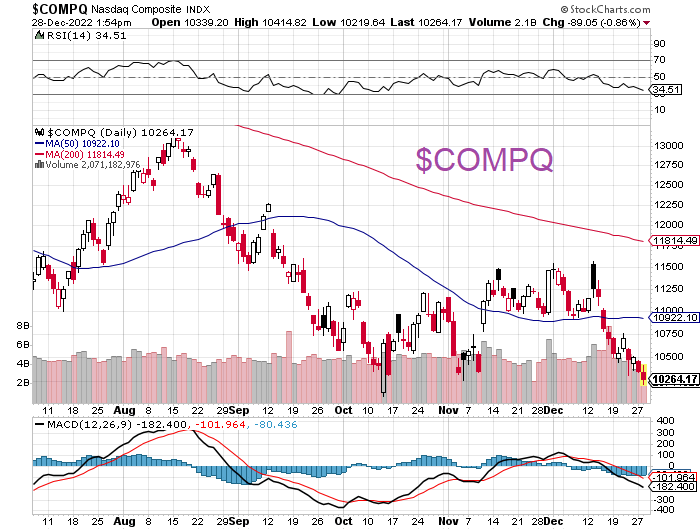
Nasdaq Composite: -26.7% YTD

Thursday, June 16, 2022

Market update: Federal Reserve hikes short-term rates by 0.75% (15 June 22)

S&P 500 after the Fed's 75-basis point rate hike yesterday, which was the largest move in 28 years.

Several central banks elsewhere also raising their key rates:  the Swiss National Bank surprised overnight with a 50-basis point rate hike (its first hike in 15 years), Brazil's central bank raised its key lending rate by 50 basis points, and the Bank of England increased its key lending rate by 25 basis points while projecting a 0.3% decline in Q2 GDP as a whole. 


Wednesday, May 4, 2022

Market update: Federal Reserve hikes short-term rates by 0.50% (4 May 2022)

The Federal Reserve increased short-term interest rates on Wednesday, as expected, raising the fed funds target range by 50 basis points to 0.75-1.00%, the biggest increase in 22 years.  The stock market surged and Treasury yields fell as Fed chief Jerome Powell signaled supersize rate hikes are off the table in June and July.


Fed chief Powell says it's crucial that inflation is brought down quickly. But Powell said he sees rate hikes of "50 basis points" on the table for the next couple of Fed meetings. He added that policymakers aren't actively considering 75 basis points. Markets had priced in a good chance of three-quarters of a point hikes at the June and July Fed meetings.

Fed chief Powell's less-hawkish-than-feared rate-hike forecast sent stocks sharply higher and Treasury yields lower.

Dow Jones Industrial Average -6.3% YTD
S&P 500 -9.8% YTD
Russell 2000 -13.2% YTD
Nasdaq Composite -17.1% YTD

 
 All 11 S&P 500 sectors closed higher with gains ranging from 1.1% (real estate) to 4.1% (energy). Ten sectors advanced more than 2.0%.


 ** The following day **
 

Tuesday, August 17, 2021

S&P 500 has doubled from its March 2020 low

Now that the S&P 500 has doubled from its March 2020 low, what's next? 
A pullback if history is any guide.

Wednesday, July 7, 2021

Over-the-counter U.S. stocks point to fading speculation

Speculation in U.S. over-the-counter stocks appears to be fading, according to Maneesh Deshpande, a strategist at Barclays Plc. He cited the performance of the OTCQX and OTCQB composite indexes, consisting of companies that aren’t listed on the New York Stock Exchange or the Nasdaq Stock Market, in a report Tuesday. 


The OTCQX set a record on June 14 and then dropped as much as 4.3% through Tuesday, according to data compiled by Bloomberg. The OTCQB peaked on Feb. 16 and then fell as much as 20%. “Further pain is likely” in OTC shares as well as meme stocks and cryptocurrencies, Deshpande wrote.
 

Friday, June 25, 2021

Canadian shares are a bargain again

Canadian shares are a bargain at a time when “U.S. stocks look frothy,” in Bank of America Corp.’s view. Strategists Ohsung Kwon and Savita Subramanian made the argument in a report last week that compared forward price-earnings ratios for the S&P/TSX Composite and S&P 500 indexes. The valuation gauge showed Canada’s benchmark was 23% cheaper as of Friday, according to data compiled by Bloomberg. The discount bottomed out April 13 at 27%, the biggest in more than two decades. “Canada looks particularly attractive” as the global economy rebounds, the report said.


Monday, September 21, 2020

Market update: The S&P 500 corrects 10% from recent high (21 Sept 2020)

At its low today, the S&P 500 was down 10.0% from the record high it set earlier this month -- a decline often described as a "correction." This might have been the green light for many investors and traders to buy the dip in the last hour of trading. 

YTD

  • Nasdaq Composite +20.1% 
  • S&P 500 +1.6% 
  • Dow Jones Industrial Average -4.9% 
  • Russell 2000 -11.0% 


Wednesday, June 10, 2020

Market update: The Fed keeps interest rates unchanged (10 June 20)

The Federal Reserve kept the target range for the fed funds rate unchanged at 0.00-0.25%, and its dot plot signaled rates will remain near zero through at least 2022. 
The Fed's economic projections called for a 6.5% contraction in 2020 GDP, followed by 5.0% growth in 2021. Core PCE inflation is expected to remain below the Fed's 2.0% target through 2020. 


After the release of the policy directive, the S&P 500 erased prior losses and gained as much as 0.5%, but stocks quickly retraced those gains during Fed Chair Powell's press conference. Mr. Powell didn't say anything particularly new, reiterating the Fed's commitment to supporting the economy, but he did subtly urge Congress to do more. 

In the Treasury market, longer-dated maturities saw greater demand following the FOMC statement. The 2-yr yield declined three basis points to 0.17%, and the 10-yr yield declined eight basis points to 0.75%. The U.S. Dollar Index declined 0.3% to 96.02. WTI crude gained 1.6%, or $0.62, to $39.54/bbl.

Nasdaq Composite +11.7% YTD
S&P 500 -1.3% YTD
Dow Jones Industrial Average -5.4% YTD
Russell 2000 -12.1% YTD


Monday, June 8, 2020

Market update: The S&P 500 turns positive for the year (8 June 2020)

The S&P 500 turned positive for the year and the Nasdaq Composite closed at a new all-time high.
YTD:
  • Nasdaq Composite +10.6%
  • S&P 500 +0.1%
  • Dow Jones Industrial Average -3.4%
  • Russell 2000 -7.9% 

Tuesday, March 24, 2020

Dow Jones - best day since 1933

Congress nears a deal to inject $2 trillion into the economy to mitigate damage from the coronavirus outbreak.


Wednesday, March 18, 2020

Market update: trading halted for the 4th time in 8 days (18 March 2020)

At 1:12 ET, the Level 1 circuit breaker was triggered with a 7.0% decline in the S&P 500. Trading was halted for 15 minutes. This is the 4th time trading was halted in the past 8 days.

 A cross-market trading halt can be triggered at three circuit breaker thresholds that measure a decrease against the prior day's closing price of the S&P 500 Index -- 7% (Level 1), 13% (Level 2), and 20% (Level 3) (NYSE, NYSE American and NYSE Arca Rule 7.12).

YTD:
  • Nasdaq Composite: -22.1% 
  •  S&P 500: -25.8% 
  •  Dow Jones Industrial Average: -30.3% 
  •  Russell 2000: -40.6%


Monday, March 9, 2020

Market update: Dow plunges more than 2,000, oil tanks 20% (9 March 2020)

The S&P 500 dropped 7.6%, oil prices tanked 25%, and Treasury yields continued to fall to unprecedented levels on Monday after Saudi Arabia initiated a price war and coronavirus cases accelerated.  The number of reported coronavirus cases in the U.S. climbed past 500 over the weekend, while Italy placed several northern cities on lockdown on Sunday, essentially quarantining more than 15 million people.
Saudi Arabia lowered its oil price for April delivery by $6-$8/bbl and signaled production boosts for an oversupplied market after Russia failed to agree to production cuts last Friday. WTI crude settled the session down 24.8%, or $10.23, to $31.09/bbl for its worst decline since 1991, which took a heavy toll on the S&P 500 energy sector (-20.1%).
  • The Dow sank over 2,000 points Monday and oil had its worst drop since 1991. 
  • Stock trading halted for 15 minutes after S&P 500 falls 7%.  Just minutes after the stock market opened, the S&P 500 fell 7% from its previous close—triggering a circuit breaker that halted trading across the entire stock market for 15 minutes.  Trading resumed at 9:49 a.m. ET


The oil shock exacerbated recessionary concerns already fueled by the rapid spread of the coronavirus, as speculation arose about potential layoffs and defaults within the highly-leveraged energy space. The other ten S&P 500 sectors posted losses between 4.4% (consumer staples) and 10.9% (financials).

The financials space remained pressured by the sharp decline in Treasury yields, as investors continued to seek safety in bonds. The 2-yr yield fell 18 basis points to 0.32%, and the 10-yr yield fell 21 basis points to 0.50% after touching 0.34% at its low. The U.S. Dollar Index dropped 1.0% to 95.02.

Stocks were halted from trading for 15 minutes in the opening minutes of action after the S&P 500's 7.0% decline triggered a circuit breaker. At that point, the S&P 500 was down 18.5% from its all-time high and later it nearly entered bear market territory, which is typically defined as a loss of at least 20% from a recent high.

Nasdaq Composite -11.4% YTD
S&P 500 -15.0% YTD
Dow Jones Industrial Average -16.4% YTD
Russell 2000 -21.3% YTD

Energy 

Oil's plunge and the corresponding dive in the energy sector comes after Friday's news of OPEC's inability to agree to a production cut was followed by Saudi Arabia's decision to slash export prices for April while boosting production. It is expected that Russia will try to undercut the Saudi price with Goldman Sachs projecting that the price of Brent crude could fall to $20/bbl. This comes at a time when demand for oil was already expected to drop due to the impact of the coronavirus.

Notable movers:
  • Diamondback Energy (FANG 24.35, -24.21, -49.7%): falling to levels not seen since early 2013.
  • Apache (APA 12.06, -8.64, -41.7%): falling to its lowest level since 1999.
  • Marathon Oil (MRO 4.08, -2.75, -40.2%): falling to its lowest level on record.
  • Cimarex (XEC 15.10, -9.29, -38.1%): falling to its lowest level since 2009.
  • Noble Energy (NBL 9.02, -4.30, -32.2%): falling to its lowest level since 2003.
  • Pioneer Resources (PXD 70.01, -35.11, -33.4%): falling to its lowest level since 2011.
  • Valero (VLO 62.42, -0.67, -1.1%) refiner, outperforming due to lower input costs.
  • Cabot Oil & Gas (COG 18.40, +2.03, +12.5%): natural gas producer, rising to its 200-day moving average (18.43).

---Foreign Equity Markets---
  • Japan's Nikkei: -5.4%
  • Hong Kong's Hang Seng: -4.2%
  • China's Shanghai Composite: -3.0%
  • India's Sensex: -5.2%
  • South Korea's Kospi: -4.2%
  • Australia's ASX All Ordinaries: -7.4%
  • STOXX Europe 600: -6.8%
  • Germany's DAX: -7.4%
  • U.K.'s FTSE 100: -7.1%
  • France's CAC 40: -7.6%
  • Italy's FTSE MIB: -10.7%
  • Spain's IBEX 35: -7.7%

Tuesday, March 3, 2020

Market update: Fed cuts rates by 0.50% to blunt coronavirus impact (3 March 2020)

Federal Reserve announces "surprise" 50 basis points cut in target range for federal funds rate to 1.00% to 1.25%, citing evolving risks to economic outlook posed by the coronavirus.
  • The surprise 50 basis point cut came with commentary highlighting the limits of monetary policy, and Wall Street indexes fell sharply, gold surged and the dollar sank. 
  • The yield on benchmark 10-year U.S. Treasuries, which falls when prices rise, hit a once unimaginable low of 0.9060%.
The Fed cut failed to lift confidence. Wall Street tumbled in a volatile session on Tuesday, amplifying fears about the magnitude of the coronavirus’ impact on the economy.


All three major U.S. stock market indexes closed nearly 3% lower after the Fed’s first emergency rate cut since the 2008 financial crisis.

The rate reduction underscored the U.S. central bank’s concern about the new coronavirus, which has spread around the world after emerging late last year in China. It came two weeks ahead of a scheduled policy meeting, where traders had fully priced in a 50-basis-point cut.

Stocks had initially jumped more than 1%, but then dropped as traders worried whether pumping more money into financial markets would address the central problem - a drop in business activity as workers and consumers stay home.

The 10-year Treasury yield fell below 1% for the first time ever as nervous investors moved money out of the stock market.

The S&P financials index tumbled 3.7%, reflecting banks’ difficulty in making profits in low-interest rate environments.

Nasdaq Composite -3.2% YTD
S&P 500 -7.0% YTD
Dow Jones Industrial Average -9.2% YTD
Russell 2000 -10.9% YTD

Friday, January 31, 2020

Market update (31 January 20)

The stock market sold off to end the week, and month, on growing concerns about the coronavirus and the negative effect it could have on economic growth.  

The coronavirus angst was exacerbated by increasing reports of worldwide cases; Delta Air Lines (DAL), United Airlines (UAL), and American Airlines (AAL) suspending U.S.-China flights; and the White House declaring a public health emergency in addition to announcing some travel restrictions. 

 
Fri, Jan 31, 20

Worried by the mounting death toll from the coronavirus and drastic efforts to contain it, investors dashed for the exits,

coronavirus-related stocks on Fri Jan 31, 20

S&P 500, 14 months

YTD
Nasdaq Composite +2.0% 
S&P 500 -0.2%  
Dow Jones Industrial Average -1.0%  
Russell 2000 -3.3%  

GSG commodity index, renko chart


The Economist, Bloomberg Businessweek covers

sold out masks at CVS

Latest coronavirus news:  
- Chinese authorities have reported more than 350 fatalities
- China has banned burials or funerals for virus victims
- There are over 14,000 confirmed cases worldwide
- Hong Kong, Japan, Singapore, UAE and the US have confirmed more infections
- The outbreak has reached more than two dozen countries and regions globally
- Several countries are halting flights to and from China
- WHO declared the virus was a public health emergency of international concern

Update Tue Feb 4, 20: China injects $57 billion into banks

Friday, November 29, 2019

Market update (29 Nov 2019)

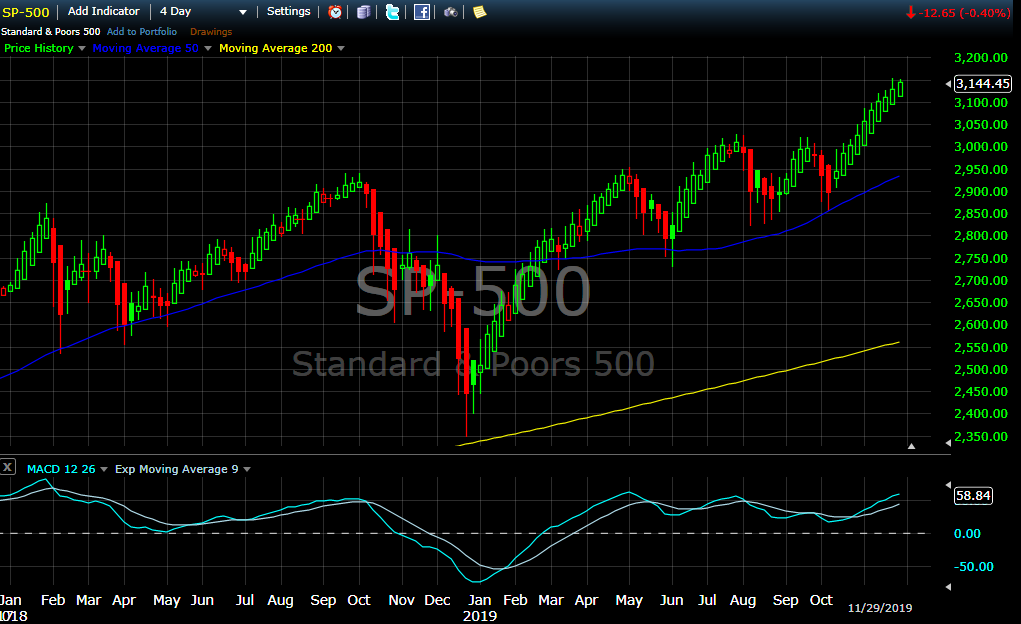
Nasdaq Composite +30.6% YTD
S&P 500 +25.3% YTD
Russell 2000 +20.5% YTD
Dow Jones Industrial Average +20.3% YTD

S&P 500 - 2 years

Wednesday, October 30, 2019

Market update: Federal Reserve cuts interest rates by 0.25% for the third time this year (30 Oct 2019)

3rd rate cut this year:  The Federal Reserve did exactly what was expected Wednesday by lowering its key policy interest rate one-quarter percentage point, to a range of 1.50%-1.75% and implying in the directive that it is unlikely to cut the fed funds rate again in December.
Fed Chair Powell, at his press conference, provided some dovish fodder with the suggestion that the Fed will need to see a significant move higher in inflation to raise interest rates to address such a development.
  • Nasdaq Composite +24.7% YTD
  • S&P 500 +21.1% YTD
  • Russell 2000 +17.0% YTD
  • Dow Jones Industrial Average +16.1% YTD


Friday, September 20, 2019

Market outlook : S&P 500 at major resistance level (20 Sept 2019)

  • The all-time high close on the S&P 500 is 3025.86, set on July 26, 2019. 
  • On Thursday, the S&P 500 hit 3021.99, less than 4 points from that key level.