Showing posts with label Russell 2000. Show all posts

Monday, January 30, 2023

Nasdaq 100 on pace for best January since 1999

The Nasdaq 100 Stock Index is on pace for its best January since 1999 despite warning signs from the likes of Microsoft Corp. and Intel Corp. and another expected interest-rate hike from the Federal Reserve. The Cboe Volatility Index sank within striking distance of a 10-month low on Friday, signalling less angst in the market. Meanwhile, options trading on megacaps last week showed demand hasn’t jumped for protection against a selloff.


Monday, December 20, 2021

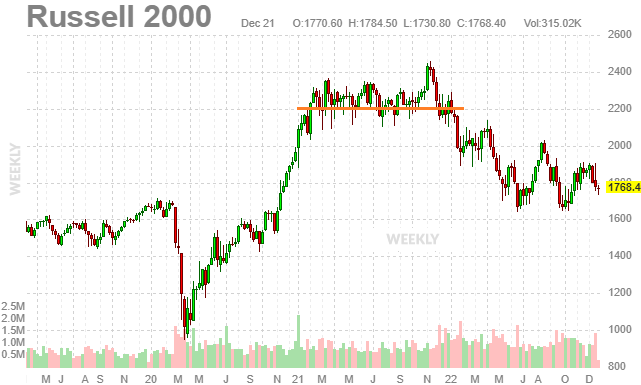
Russell 2000 at a long-term support of ~2100


Update one year later (Dec 20, 22)
  • Russell 2000 dropped more than 20%, and is currently  -22.2% YTD.

Friday, November 5, 2021

Broader Russell 2000 gains are seen as economic positive

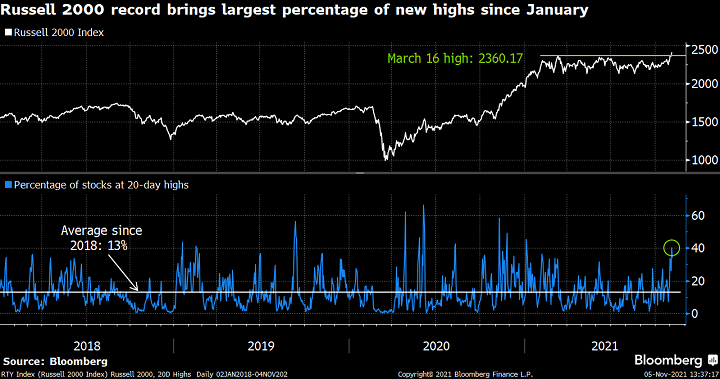
Smaller U.S. companies are sending a positive signal for the economy, according to Chris Verrone, head of technical and macro research at Strategas Research Partners LLC. He cited broadening gains within the Russell 2000 Index in a Twitter post Thursday. More than 40% of the Russell’s component stocks closed at 20-day highs Wednesday as the index set a record, according to data compiled by Bloomberg. The percentage was the largest since January and more than triple the average since 2018.


** 7 months later **

Friday, June 4, 2021

Russell 2000 to lose AMC Entertainment, GameStop

This month’s overhaul of the Russell 2000 Index may prove costly for the gauge of smaller U.S. companies. The two biggest contributors to the measure’s 15% surge for the year through Thursday were AMC Entertainment Holdings Inc. and GameStop Corp. -- standouts among so-called meme stocks. Both are poised for transfers out of the gauge and into the Russell 1000 Index of larger companies on June 28, when FTSE Russell completes an annual reconstitution of U.S. indexes. The shift would reflect the companies’ market value: $26.4 billion for AMC and $19.2 billion for GameStop as of Thursday. 

Monday, September 21, 2020

Market update: The S&P 500 corrects 10% from recent high (21 Sept 2020)

At its low today, the S&P 500 was down 10.0% from the record high it set earlier this month -- a decline often described as a "correction." This might have been the green light for many investors and traders to buy the dip in the last hour of trading. 

YTD

  • Nasdaq Composite +20.1% 
  • S&P 500 +1.6% 
  • Dow Jones Industrial Average -4.9% 
  • Russell 2000 -11.0% 


Monday, June 8, 2020

Market update: The S&P 500 turns positive for the year (8 June 2020)

The S&P 500 turned positive for the year and the Nasdaq Composite closed at a new all-time high.
YTD:
  • Nasdaq Composite +10.6%
  • S&P 500 +0.1%
  • Dow Jones Industrial Average -3.4%
  • Russell 2000 -7.9% 

Friday, November 29, 2019

Market update (29 Nov 2019)

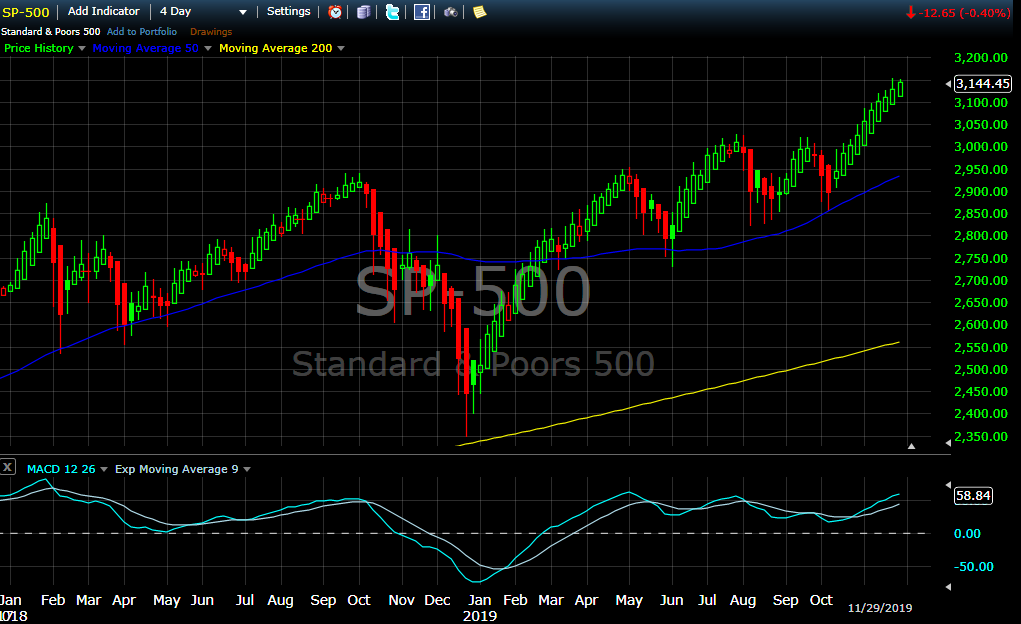
Nasdaq Composite +30.6% YTD
S&P 500 +25.3% YTD
Russell 2000 +20.5% YTD
Dow Jones Industrial Average +20.3% YTD

S&P 500 - 2 years

Tuesday, March 19, 2019

Market update: key market catalysts (19 March 2019)

SPY daily and monthly

$SPX last 5 sessions

1.  Bank of America/Merrill Lynch fund manager survey
  • Latest survey showed allocation to equities is at its lowest since September 2016.  Implies many fund managers have missed/trailed the 2019 rally effort and will need to play catch up, providing more fuel to keep the rally going.
2.  Green shoots of economic optimism
  • Economic sentiment in Germany was better than expected in March and employment trends in the UK were also better than expected, highlighted by the lowest unemployment rate (3.9%) since 1975, according to Reuters.
  • The reassuring data helped stoke the narrative that the global economy may be bottoming (or has bottomed), which has driven buying interest in cyclical sectors.
3.  Ongoing leadership from the semiconductor stocks
  • This industry group is regarded as having leading indicator status, so it resonates as a positive marker that the Philadelphia Semiconductor Index is up 21.9% year-to-date, including today's 1.4% gain.
  • Strength in the semis has been a key source of support for the information technology sector (+0.3%), which is the market's most heavily-weighted sector.
4.  Frontrunning the Fed
  • The stock market knows the Fed is on its side at the moment.  On Wednesday, it expects the FOMC to reinforce that position by holding the fed funds rate steady and reiterating a patient mindset. 
  • This expectation, and the speculation that the dot plot will show a reduced rate-hike projection for 2019 (the median estimate in December called for two rate hikes), and that the Fed could announce a plan regarding the timing for ending its balance sheet runoff, have helped keep selling interest in check.

President Trump hosts Brazil’s new leader

Today, President Trump welcomed the recently elected President of Brazil, Jair Bolsonaro, to the White House.

President Bolsonaro’s election marked a historic opportunity for the United States and Brazil—the two largest democracies in the Western Hemisphere—to build a new partnership focused on increased prosperity, strong security, and national sovereignty.

Perhaps most important, Brazil is a crucial ally in President Trump’s stand against the corrupt, socialist Maduro dictatorship in Venezuela. President Bolsonaro reiterated that Brazil stands with Venezuelan Interim President Juan Guaido, as well as with the democratically elected National Assembly and the Venezuelan people in their fight against tyranny.

“The twilight hour of socialism has arrived in our hemisphere,” President Trump said from the Rose Garden this afternoon. “And hopefully, by the way, it’s also arrived—that twilight hour—in our great country.”

“I have always admired the United States of America,” President Bolsonaro added. “And this sense of admiration has just increased after you took office.”

President Trump said he will designate Brazil as a major non-NATO ally during the visit of Brazil's President Jair Bolsonaro to the White House. Argentina is the only other South American country with that designation.


President Jair Bolsonaro, left, presents Donald Trump with a Brazil national football jersey after the US leader gave him a US soccer team shirt

Monday, March 18, 2019

Growth-stock strength shifts into smaller U.S. companies

Renewed demand for U.S. growth stocks has done more for shares of smaller companies than their larger peers. The ratio between the Russell 2000 growth and value indexes rose Friday to its highest level since February 2001, while a similar gauge that’s based on the S&P 500 Index failed to surpass an 18-year peak reached on Sept. 28. The Russell 2000 ratio climbed 7.9 percent from its most recent low, on Nov. 19, through Friday. During the same period, the S&P 500’s growth and value indicator only added 5.4 percent.

Tuesday, February 5, 2019

The Trump trade

Market performance since the Nov. 2016 election.


These billionaires benefited the most from Trump policies.

Wednesday, September 26, 2018

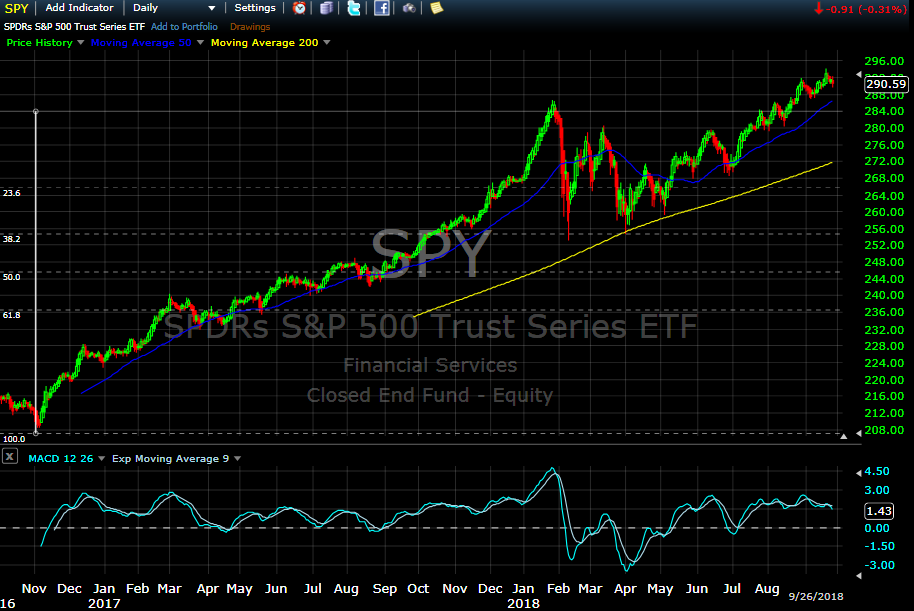
Market update: Federal Reserve hikes short-term rates by 0.25% (26 September 2018)

The Federal Reserve increased short-term interest rates on Wednesday, as expected, raising the fed funds target range by 25 basis points to 2.00-2.25%.
  • Fed hikes interest rates, raises its economic outlook and drops 'accommodative' language
  • Fed's Powell: Lack of 'accomodative' language a sign policy inline with expectations


Stocks were up modestly ahead of the release of the Fed's decision, which crossed the wires at 2:00 PM ET, and extended gains after the central bank removed the word 'accommodative' from its policy statement. However, that initial move was reversed, and then some, following a post-decision press conference from Fed Chairman Jerome Powell, during which he said the language change didn't signal a change in the Fed's path for rate hikes.

The S&P 500 was up as much as 0.5% on Wednesday but fell sharply in the final minutes of the session to finish with a loss of 0.3%. The tech-heavy Nasdaq Composite ended lower by 0.2%, the blue-chip Dow Jones Industrial Average finished lower by 0.4%, and the small-cap Russell 2000 lost 1.0%.

As for rate-hike projections, the Fed still appears to be on track to raise rates another 25 basis points in December, with the CME FedWatch Tool putting the chances at 79.2%. Beyond 2018, the Fed's dot plot showed expectations for three rate hikes in 2019 (unchanged from June) and one in 2020 (also unchanged from June).

U.S. Treasury yields fell following the Fed's policy announcement, although the 2-yr yield managed to close unchanged at 2.83%. The yield on the benchmark 10-yr Treasury note dropped four basis points to 3.06%. In currencies, the U.S. Dollar Index finished +0.2% at 93.90, but was volatile after the release.

The drop in Treasury yields weighed on the rate-sensitive financial sector, which finished at the bottom of the sector standings with a loss of 1.3%. The energy sector (-1.0%) was another notable laggard, dropping in tandem with the price of crude oil; WTI crude futures finished -1.0% at $71.58/bbl.

Monday, September 11, 2017

Go large for U.S. stock leaders, OppeheimerFunds says

Larger U.S. companies are poised to extend years of gains relative to smaller peers, according to Talley Leger, an equity strategist at OppenheimerFunds. He cited the ratio between the S&P 500 and Russell 2000 indexes, which rebounded 13 percent through Friday from an almost three-decade low in March 2014, in a report last week. “The current wave of large-cap outperformance” may last at least two more years, Leger wrote, if history is any indication. Relatively slow economic growth, a weaker dollar and a brighter earnings outlook are among reasons to favor large caps now, in his view.

Friday, March 31, 2017

Market update (31 March 2017)

The major indices are doing extremely well.


Now let's discuss the five areas where we had warnings in 2007:

1. The weekly MACD could not be any stronger.  It has been rising with each price breakout, suggesting that momentum is accelerating, not weakening as it was in 2007.

2. There clearly have been no price violations.  If anything, the S&P 500 consolidated from 2014 to mid-2016, before breaking out in a big way post-Brexit, then again after the November U.S. presidential election.

3. The XLY:XLP ratio has been climbing nicely over the past year - much different than what we saw in 2007 - but we haven't cleared the 2015 relative high.  A breakout above that level would be extremely bullish.

4. Transports vs. utilities have also increased significantly since November, a good sign, but we haven't seen this ratio clear its early 2015 high and the ratio has been falling in 2017 thus far.

5. The RUT:SPX ratio has been declining since 2014, but it's very strong for the past year.

The absolute price action on major indices is very strong and relative price action continues to support a higher S&P 500 in 2017.  Breakouts on the above key relative ratios would add confirmation to this belief while deterioration in these ratios going forward would be warning flags to be confirmed by price breakdowns.

Monday, March 7, 2016

Market outlook : Russell 2000 (7 March 2016)


The Russell 2000 (small caps) has been outperforming the larger cap S&P 500:


Wednesday, November 25, 2015

Market outlook : Russell 2000 (25 Nov 2015)

The level to watch on the Russell 2000 is 1200. A break above that level would be bullish for this index as shown below: