| Company | Symbol | Dividend yield | Sector |
|---|---|---|---|
| Verizon Communications | (VZ) | 6.5% | Communication Services |
| Dow | (DOW) | 5.5 | Materials |
| Intel | (INTC) | 5.5 | Information Technology |
| Walgreens Boots Alliance | (WBA) | 5.2 | Consumer Staples |
| 3M | (MMM) | 4.9 | Industrials |
| International Business Machines | (IBM) | 4.7 | Information Technology |
| Chevron | (CVX) | 3.3 | Energy |
| Amgen | (AMGN) | 3.3 | Health Care |
| Cisco Systems | (CSCO) | 3.2 | Information Technology |
| JPMorgan Chase | (JPM) | 3.0 | Financials |
| Goldman Sachs | (GS) | 2.9 | Financials |

Showing posts with label Dow Jones. Show all posts
Showing posts with label Dow Jones. Show all posts
Thursday, January 5, 2023
Highest dividend yielding stocks in Dow Jones Industrial Average

Wednesday, December 28, 2022
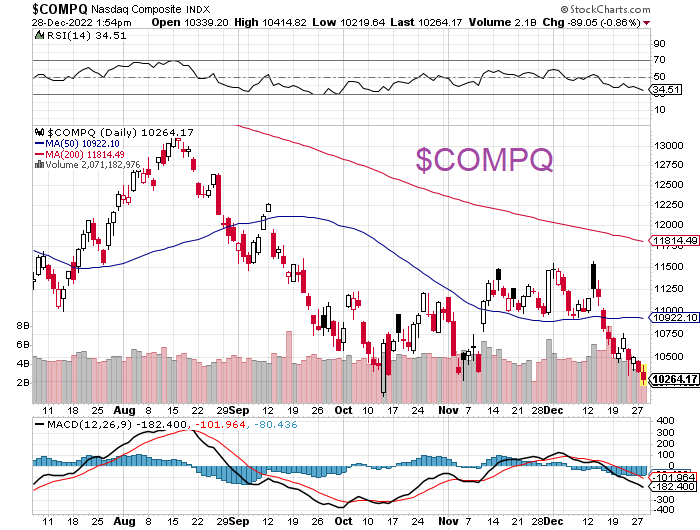
Market update: S&P 500 dips below 3,800 Dow dips below 33,000 (28 Dec 22)
S&P 500 dips below 3,800
Dow dips below 33,000


Dow dips below 33,000
Nasdaq dips below 10,300


Friday, February 11, 2022


Monday, March 8, 2021
Dow average pays a price as Exxon gives way to Salesforce
The Dow Jones Industrial Average would have been decidedly better off without a change made more than six months ago. Exxon Mobil Corp., which had been in the Dow since 1928, was removed and Salesforce.com Inc. took its place. Exxon climbed 53% from Aug. 31, the date of its ouster, through Friday. Only Goldman Sachs Group Inc. and Caterpillar Inc. posted bigger gains in the period among the average’s 30 stocks, according to data compiled by Bloomberg. Salesforce, on the other hand, was the Dow industrials’ worst performer. The business-software maker fell 23% and cost the average about 400 points, or 1.3%.


Monday, September 21, 2020
Market update: The S&P 500 corrects 10% from recent high (21 Sept 2020)
At its low today, the S&P 500 was down 10.0% from the record high it set earlier this month -- a decline often described as a "correction." This might have been the green light for many investors and traders to buy the dip in the last hour of trading.
YTD
- Nasdaq Composite +20.1%
- S&P 500 +1.6%
- Dow Jones Industrial Average -4.9%
- Russell 2000 -11.0%

Monday, August 31, 2020
Dow's newest stocks leave their predecessors behind
The Dow Jones Industrial Average’s three newest members have the potential to bolster its performance, if recent history is any guide. All three outdid their predecessors after the Dow’s components changed in June 2018, according to data compiled by Bloomberg. Salesforce.com Inc. set the pace by more than doubling, largely because of a well-received earnings report last week. Amgen Inc. and Honeywell International Inc. also gained. Among the companies they replaced, only Pfizer Inc. rose for the period. Exxon Mobil Corp. and Raytheon Technologies Corp. posted losses. 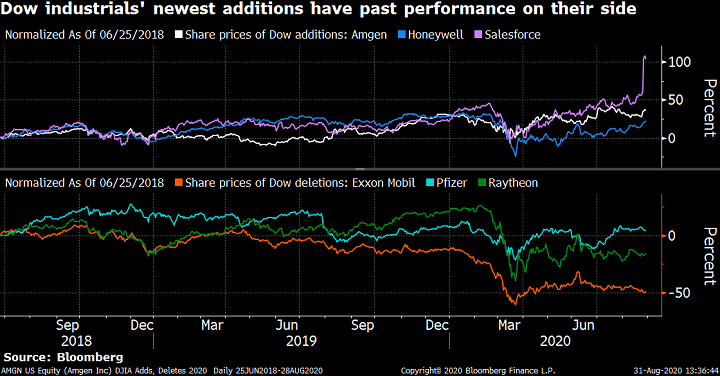

Monday, June 8, 2020
Market update: The S&P 500 turns positive for the year (8 June 2020)
The S&P 500 turned positive for the year and the Nasdaq Composite closed at a new all-time high.
YTD:
- Nasdaq Composite +10.6%
- S&P 500 +0.1%
- Dow Jones Industrial Average -3.4%
- Russell 2000 -7.9%

Tuesday, March 24, 2020
Dow Jones - best day since 1933
Congress nears a deal to inject $2 trillion into the economy to mitigate damage from the coronavirus outbreak.

Monday, March 9, 2020
Market update: Dow plunges more than 2,000, oil tanks 20% (9 March 2020)
The S&P 500 dropped 7.6%, oil prices tanked 25%, and Treasury yields continued to fall to unprecedented levels on Monday after Saudi Arabia initiated a price war and coronavirus cases accelerated. The number of reported coronavirus cases in the U.S. climbed past 500 over the weekend, while Italy placed several northern cities on lockdown on Sunday, essentially quarantining more than 15 million people.
Saudi Arabia lowered its oil price for April delivery by $6-$8/bbl and signaled production boosts for an oversupplied market after Russia failed to agree to production cuts last Friday. WTI crude settled the session down 24.8%, or $10.23, to $31.09/bbl for its worst decline since 1991, which took a heavy toll on the S&P 500 energy sector (-20.1%).


The oil shock exacerbated recessionary concerns already fueled by the rapid spread of the coronavirus, as speculation arose about potential layoffs and defaults within the highly-leveraged energy space. The other ten S&P 500 sectors posted losses between 4.4% (consumer staples) and 10.9% (financials).
The financials space remained pressured by the sharp decline in Treasury yields, as investors continued to seek safety in bonds. The 2-yr yield fell 18 basis points to 0.32%, and the 10-yr yield fell 21 basis points to 0.50% after touching 0.34% at its low. The U.S. Dollar Index dropped 1.0% to 95.02.
Stocks were halted from trading for 15 minutes in the opening minutes of action after the S&P 500's 7.0% decline triggered a circuit breaker. At that point, the S&P 500 was down 18.5% from its all-time high and later it nearly entered bear market territory, which is typically defined as a loss of at least 20% from a recent high.
Nasdaq Composite -11.4% YTD
Saudi Arabia lowered its oil price for April delivery by $6-$8/bbl and signaled production boosts for an oversupplied market after Russia failed to agree to production cuts last Friday. WTI crude settled the session down 24.8%, or $10.23, to $31.09/bbl for its worst decline since 1991, which took a heavy toll on the S&P 500 energy sector (-20.1%).
- The Dow sank over 2,000 points Monday and oil had its worst drop since 1991.
- Stock trading halted for 15 minutes after S&P 500 falls 7%. Just minutes after the stock market opened, the S&P 500 fell 7% from its previous close—triggering a circuit breaker that halted trading across the entire stock market for 15 minutes. Trading resumed at 9:49 a.m. ET


The oil shock exacerbated recessionary concerns already fueled by the rapid spread of the coronavirus, as speculation arose about potential layoffs and defaults within the highly-leveraged energy space. The other ten S&P 500 sectors posted losses between 4.4% (consumer staples) and 10.9% (financials).
The financials space remained pressured by the sharp decline in Treasury yields, as investors continued to seek safety in bonds. The 2-yr yield fell 18 basis points to 0.32%, and the 10-yr yield fell 21 basis points to 0.50% after touching 0.34% at its low. The U.S. Dollar Index dropped 1.0% to 95.02.
Stocks were halted from trading for 15 minutes in the opening minutes of action after the S&P 500's 7.0% decline triggered a circuit breaker. At that point, the S&P 500 was down 18.5% from its all-time high and later it nearly entered bear market territory, which is typically defined as a loss of at least 20% from a recent high.
Nasdaq Composite -11.4% YTD
S&P 500 -15.0% YTD
Dow Jones Industrial Average -16.4% YTD
Russell 2000 -21.3% YTD
Energy
Oil's plunge and the corresponding dive in the energy sector comes after Friday's news of OPEC's inability to agree to a production cut was followed by Saudi Arabia's decision to slash export prices for April while boosting production. It is expected that Russia will try to undercut the Saudi price with Goldman Sachs projecting that the price of Brent crude could fall to $20/bbl. This comes at a time when demand for oil was already expected to drop due to the impact of the coronavirus.
Notable movers:
Oil's plunge and the corresponding dive in the energy sector comes after Friday's news of OPEC's inability to agree to a production cut was followed by Saudi Arabia's decision to slash export prices for April while boosting production. It is expected that Russia will try to undercut the Saudi price with Goldman Sachs projecting that the price of Brent crude could fall to $20/bbl. This comes at a time when demand for oil was already expected to drop due to the impact of the coronavirus.
Notable movers:
- Diamondback Energy (FANG 24.35, -24.21, -49.7%): falling to levels not seen since early 2013.
- Apache (APA 12.06, -8.64, -41.7%): falling to its lowest level since 1999.
- Marathon Oil (MRO 4.08, -2.75, -40.2%): falling to its lowest level on record.
- Cimarex (XEC 15.10, -9.29, -38.1%): falling to its lowest level since 2009.
- Noble Energy (NBL 9.02, -4.30, -32.2%): falling to its lowest level since 2003.
- Pioneer Resources (PXD 70.01, -35.11, -33.4%): falling to its lowest level since 2011.
- Valero (VLO 62.42, -0.67, -1.1%) refiner, outperforming due to lower input costs.
- Cabot Oil & Gas (COG 18.40, +2.03, +12.5%): natural gas producer, rising to its 200-day moving average (18.43).
---Foreign Equity Markets---
- Japan's Nikkei: -5.4%
- Hong Kong's Hang Seng: -4.2%
- China's Shanghai Composite: -3.0%
- India's Sensex: -5.2%
- South Korea's Kospi: -4.2%
- Australia's ASX All Ordinaries: -7.4%
- STOXX Europe 600: -6.8%
- Germany's DAX: -7.4%
- U.K.'s FTSE 100: -7.1%
- France's CAC 40: -7.6%
- Italy's FTSE MIB: -10.7%
- Spain's IBEX 35: -7.7%
Tuesday, March 3, 2020
Market update: Fed cuts rates by 0.50% to blunt coronavirus impact (3 March 2020)
Federal Reserve announces "surprise" 50 basis points cut in target range for federal funds rate to 1.00% to 1.25%, citing evolving risks to economic outlook posed by the coronavirus.

All three major U.S. stock market indexes closed nearly 3% lower after the Fed’s first emergency rate cut since the 2008 financial crisis.
The rate reduction underscored the U.S. central bank’s concern about the new coronavirus, which has spread around the world after emerging late last year in China. It came two weeks ahead of a scheduled policy meeting, where traders had fully priced in a 50-basis-point cut.
- The surprise 50 basis point cut came with commentary highlighting the limits of monetary policy, and Wall Street indexes fell sharply, gold surged and the dollar sank.
- The yield on benchmark 10-year U.S. Treasuries, which falls when prices rise, hit a once unimaginable low of 0.9060%.

The rate reduction underscored the U.S. central bank’s concern about the new coronavirus, which has spread around the world after emerging late last year in China. It came two weeks ahead of a scheduled policy meeting, where traders had fully priced in a 50-basis-point cut.
Stocks had initially jumped more than 1%, but then dropped as traders worried whether pumping more money into financial markets would address the central problem - a drop in business activity as workers and consumers stay home.
The 10-year Treasury yield fell below 1% for the first time ever as nervous investors moved money out of the stock market.
The S&P financials index tumbled 3.7%, reflecting banks’ difficulty in making profits in low-interest rate environments.
Nasdaq Composite -3.2% YTD
S&P 500 -7.0% YTD
Dow Jones Industrial Average -9.2% YTD
Russell 2000 -10.9% YTD
Nasdaq Composite -3.2% YTD
S&P 500 -7.0% YTD
Dow Jones Industrial Average -9.2% YTD
Russell 2000 -10.9% YTD
Friday, January 31, 2020
Market update (31 January 20)
The stock market sold off to end the week, and month, on growing concerns about the coronavirus and the negative effect it could have on economic growth.
The coronavirus angst was exacerbated by increasing reports of worldwide cases; Delta Air Lines (DAL), United Airlines (UAL), and American Airlines (AAL) suspending U.S.-China flights; and the White House declaring a public health emergency in addition to announcing some travel restrictions.

Fri, Jan 31, 20


Worried by the mounting death toll from the coronavirus and drastic efforts to contain it, investors dashed for the exits,

coronavirus-related stocks on Fri Jan 31, 20

YTD
Nasdaq Composite +2.0%
S&P 500 -0.2%
Dow Jones Industrial Average -1.0%
Russell 2000 -3.3%

GSG commodity index, renko chart


The Economist, Bloomberg Businessweek covers

sold out masks at CVS
Latest coronavirus news:
- Chinese authorities have reported more than 350 fatalities
- China has banned burials or funerals for virus victims
- There are over 14,000 confirmed cases worldwide
- Hong Kong, Japan, Singapore, UAE and the US have confirmed more infections
- The outbreak has reached more than two dozen countries and regions globally
- Several countries are halting flights to and from China
- WHO declared the virus was a public health emergency of international concern
Update Tue Feb 4, 20: China injects $57 billion into banks

Friday, November 29, 2019
Market update (29 Nov 2019)
Nasdaq Composite +30.6% YTD
S&P 500 +25.3% YTD
Russell 2000 +20.5% YTD
Dow Jones Industrial Average +20.3% YTD
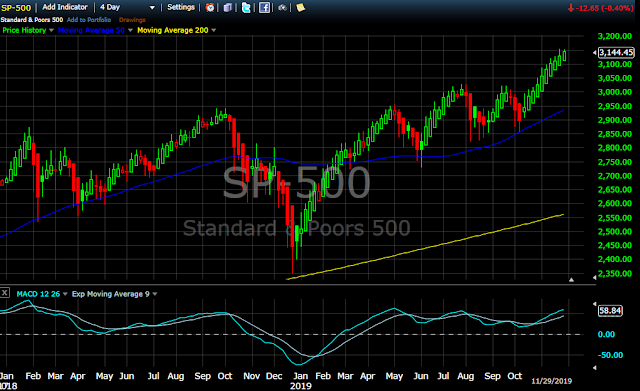
S&P 500 +25.3% YTD
Russell 2000 +20.5% YTD
Dow Jones Industrial Average +20.3% YTD
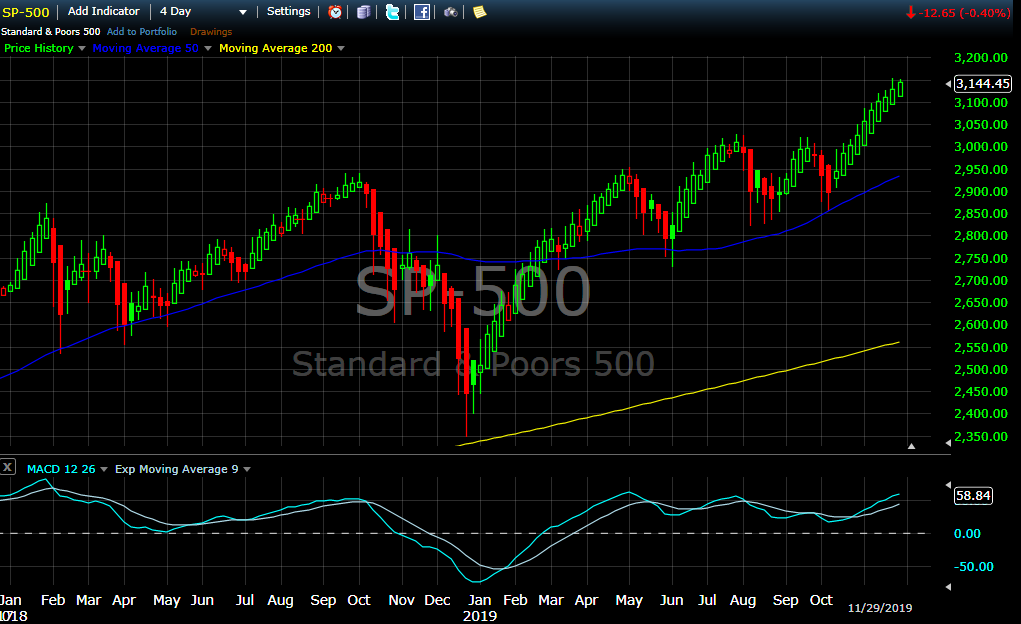
S&P 500 - 2 years


Wednesday, October 30, 2019
Market update: Federal Reserve cuts interest rates by 0.25% for the third time this year (30 Oct 2019)
3rd rate cut this year: The Federal Reserve did exactly what was expected Wednesday by lowering its key policy interest rate one-quarter percentage point, to a range of 1.50%-1.75% and implying in the directive that it is unlikely to cut the fed funds rate again in December.
Fed Chair Powell, at his press conference, provided some dovish fodder with the suggestion that the Fed will need to see a significant move higher in inflation to raise interest rates to address such a development.


Fed Chair Powell, at his press conference, provided some dovish fodder with the suggestion that the Fed will need to see a significant move higher in inflation to raise interest rates to address such a development.
- Nasdaq Composite +24.7% YTD
- S&P 500 +21.1% YTD
- Russell 2000 +17.0% YTD
- Dow Jones Industrial Average +16.1% YTD


Wednesday, September 18, 2019
Market update: Federal Reserve cuts interest rates by 0.25% for the second time this year (18 September 2019)
FOMC Decision: Fed cuts its benchmark overnight lending rate 25 bps to 1.75-2.00% as widely expected
There was a 7-3 vote to cut the target range for the fed funds rate by 25 bps to 1.75-2.00%. Boston Fed President Rosengren and Kansas City Fed President George dissented on the belief the target range should be left unchanged at 2.00-2.25%. St. Louis Fed President Bullard dissented on the belief the target range should be cut by 50 basis points.
- Nasdaq Composite +23.2% YTD
- S&P 500 +19.9% YTD
- Dow Jones Industrial Average +16.4% YTD
- Russell 2000 +16.3% YTD


The FOMC voted 7-3 to cut the target range for the fed funds rate by 25 basis points to 1.75-2.00%, as expected. Price action leading up to the decision was muted and volatility quickly ensued after the policy directive. Buying conviction, however, was largely absent before and immediately after the decision as the market extended losses heading into Fed Chair Powell's press conference.
Key takeaways from the Fed's policy decision included:
(1) Voting members remained divided: St. Louis Fed President Bullard preferred a 50-basis points cut, while Boston Fed President Rosengren and Kansas City Fed President George preferred no change in the fed funds rate; (2) the median Fed member is suggesting there will be no more rate cuts in 2019 and 2020; and (3) the interest paid on excess reserve balances was lowered to 1.80% from 2.10% -- which could provide some stability in the repo market after the New York Fed injected more liquidity today.
Selling pressure soon abated and stocks climbed to session highs, with the S&P 500 financials sector (+0.4%) providing influential leadership, as the Fed Chair Powell wrapped up his press conference. The utilities sector (+0.5%) outperformed, while the energy sector (-0.4%) underperformed as oil prices ($58.07/bbl, -1.30, -2.2%) continued to pull back.
Mr. Powell said the Fed does not see a recession, is not interested in negative rates, and the repo issue has no implications for the economy or monetary policy. FedEx (FDX), meanwhile, provided a pessimistic view on the global economy. The company cut its FY20 EPS guidance due to a weakening global environment, driven by trade tensions and policy uncertainty.
President Donald Trump, who has been bashing the Fed on Twitter and demanding a larger cut, was predictably fast on his fingers.

President Trump, who has called Fed policymakers “boneheads” for not cutting rates enough, tore into Wednesday’s decision, saying Chairman Jay Powell and his colleagues have “no ‘guts.’” Trump says the Fed is risking U.S. competitiveness by keeping rates substantially higher than most of the rest of the developed world.
But Powell said he does not believe the Fed will ever resort to negative rates, instead relying on asset purchases and forward guidance, as it did following the 2008 financial crisis. For now, though, Powell foresees continued moderate growth for the U.S. economy.
President Donald Trump, who has been bashing the Fed on Twitter and demanding a larger cut, was predictably fast on his fingers.
But Powell said he does not believe the Fed will ever resort to negative rates, instead relying on asset purchases and forward guidance, as it did following the 2008 financial crisis. For now, though, Powell foresees continued moderate growth for the U.S. economy.
Tuesday, March 19, 2019
Market update: key market catalysts (19 March 2019)


SPY daily and monthly

$SPX last 5 sessions
- Latest survey showed allocation to equities is at its lowest since September 2016. Implies many fund managers have missed/trailed the 2019 rally effort and will need to play catch up, providing more fuel to keep the rally going.
- Economic sentiment in Germany was better than expected in March and employment trends in the UK were also better than expected, highlighted by the lowest unemployment rate (3.9%) since 1975, according to Reuters.
- The reassuring data helped stoke the narrative that the global economy may be bottoming (or has bottomed), which has driven buying interest in cyclical sectors.
- This industry group is regarded as having leading indicator status, so it resonates as a positive marker that the Philadelphia Semiconductor Index is up 21.9% year-to-date, including today's 1.4% gain.
- Strength in the semis has been a key source of support for the information technology sector (+0.3%), which is the market's most heavily-weighted sector.
- The stock market knows the Fed is on its side at the moment. On Wednesday, it expects the FOMC to reinforce that position by holding the fed funds rate steady and reiterating a patient mindset.
- This expectation, and the speculation that the dot plot will show a reduced rate-hike projection for 2019 (the median estimate in December called for two rate hikes), and that the Fed could announce a plan regarding the timing for ending its balance sheet runoff, have helped keep selling interest in check.

Today, President Trump welcomed the recently elected President of Brazil, Jair Bolsonaro, to the White House.
President Bolsonaro’s election marked a historic opportunity for the United States and Brazil—the two largest democracies in the Western Hemisphere—to build a new partnership focused on increased prosperity, strong security, and national sovereignty.
Perhaps most important, Brazil is a crucial ally in President Trump’s stand against the corrupt, socialist Maduro dictatorship in Venezuela. President Bolsonaro reiterated that Brazil stands with Venezuelan Interim President Juan Guaido, as well as with the democratically elected National Assembly and the Venezuelan people in their fight against tyranny.
“The twilight hour of socialism has arrived in our hemisphere,” President Trump said from the Rose Garden this afternoon. “And hopefully, by the way, it’s also arrived—that twilight hour—in our great country.”
“I have always admired the United States of America,” President Bolsonaro added. “And this sense of admiration has just increased after you took office.”

President Trump said he will designate Brazil as a major non-NATO ally during the visit of Brazil's President Jair Bolsonaro to the White House. Argentina is the only other South American country with that designation.

President Jair Bolsonaro, left, presents Donald Trump with a Brazil national football jersey after the US leader gave him a US soccer team shirt

President Jair Bolsonaro, left, presents Donald Trump with a Brazil national football jersey after the US leader gave him a US soccer team shirt
Tuesday, February 5, 2019
The Trump trade
Market performance since the Nov. 2016 election.

These billionaires benefited the most from Trump policies.


Tuesday, May 30, 2017
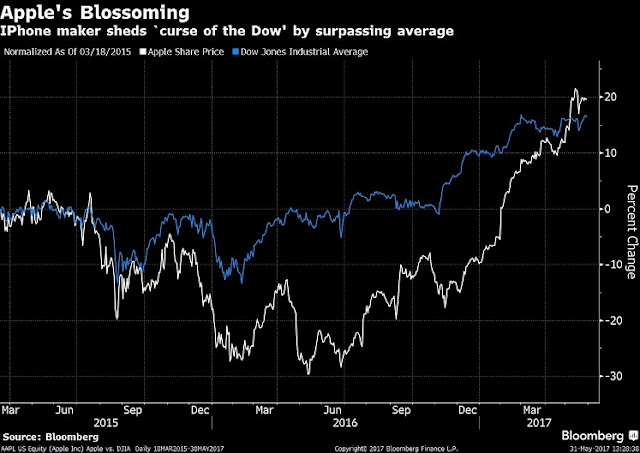
Apple sheds `curse of the Dow,' leads average's gain
Apple Inc. has overcome the “curse of the Dow,” according to Nicholas Colas, chief market strategist at Convergex Group LLC. This month brought a reversal for the iPhone maker, which had trailed the Dow Jones Industrial Average most of the time since being added in March 2015. As Apple moved ahead, the stock became the biggest contributor to the Dow’s gain this year, according to data compiled by Bloomberg. Colas highlighted the performance in a report Friday.

Friday, March 31, 2017
Market update (31 March 2017)
The major indices are doing extremely well.

Now let's discuss the five areas where we had warnings in 2007:
1. The weekly MACD could not be any stronger. It has been rising with each price breakout, suggesting that momentum is accelerating, not weakening as it was in 2007.
2. There clearly have been no price violations. If anything, the S&P 500 consolidated from 2014 to mid-2016, before breaking out in a big way post-Brexit, then again after the November U.S. presidential election.
3. The XLY:XLP ratio has been climbing nicely over the past year - much different than what we saw in 2007 - but we haven't cleared the 2015 relative high. A breakout above that level would be extremely bullish.
4. Transports vs. utilities have also increased significantly since November, a good sign, but we haven't seen this ratio clear its early 2015 high and the ratio has been falling in 2017 thus far.
5. The RUT:SPX ratio has been declining since 2014, but it's very strong for the past year.
The absolute price action on major indices is very strong and relative price action continues to support a higher S&P 500 in 2017. Breakouts on the above key relative ratios would add confirmation to this belief while deterioration in these ratios going forward would be warning flags to be confirmed by price breakdowns.
Now let's discuss the five areas where we had warnings in 2007:
1. The weekly MACD could not be any stronger. It has been rising with each price breakout, suggesting that momentum is accelerating, not weakening as it was in 2007.
2. There clearly have been no price violations. If anything, the S&P 500 consolidated from 2014 to mid-2016, before breaking out in a big way post-Brexit, then again after the November U.S. presidential election.
3. The XLY:XLP ratio has been climbing nicely over the past year - much different than what we saw in 2007 - but we haven't cleared the 2015 relative high. A breakout above that level would be extremely bullish.
4. Transports vs. utilities have also increased significantly since November, a good sign, but we haven't seen this ratio clear its early 2015 high and the ratio has been falling in 2017 thus far.
5. The RUT:SPX ratio has been declining since 2014, but it's very strong for the past year.
The absolute price action on major indices is very strong and relative price action continues to support a higher S&P 500 in 2017. Breakouts on the above key relative ratios would add confirmation to this belief while deterioration in these ratios going forward would be warning flags to be confirmed by price breakdowns.
Tuesday, September 13, 2016
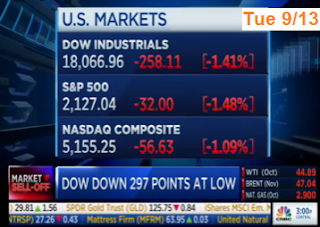
Market update: Market volatility picks up (13 Sept 2016)
Market volatility has picked up after more than 40 consecutive days of below 1% daily moves.




Subscribe to:
Posts (Atom)