
Showing posts with label solar stocks. Show all posts
Showing posts with label solar stocks. Show all posts
Friday, October 9, 2020
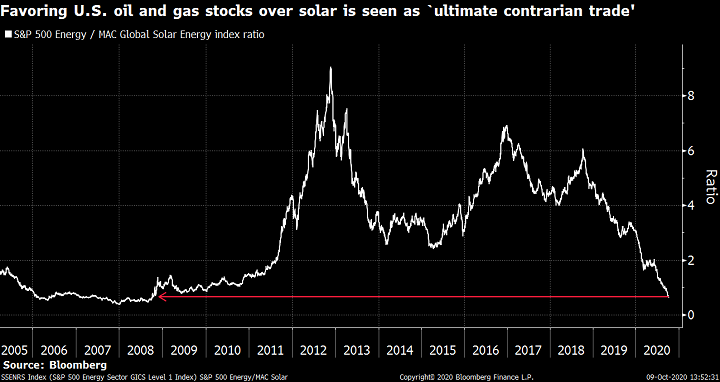
Buying oil stocks, selling solar is seen as winning trade
Owning U.S. oil and gas producers and betting against solar companies looks like “the ultimate contrarian trade” to Jonathan Krinsky, Bay Crest Partners LLC’s chief market technician. Krinsky suggested the stock trade in a report Thursday, based on a comparison between the S&P 500 Energy Index and the MAC Global Solar Energy Index. The ratio between the industry gauges closed Wednesday at the lowest level since October 2008, according to data compiled by Bloomberg. Wednesday’s reading was 90% below a peak reached two years ago, and Krinsky wrote that he sees the potential for a “sharp snapback.


Saturday, February 15, 2020
Solar stocks

- TAN Invesco Solar ETF
(by market cap)
Ticker Company name Mkt Cap▼
- SEDG Solaredge Technologies 15.294B
- ENPH Enphase Energy 13.586B
- RUN Sunrun 9.904B
- BEP Brookfield Renewable Partners L.P. 9.749B
- FSLR First Solar 8.341B
- VSLR Vivint Solar 5.422B -- to be acquired by solar peer Sunrun (RUN) for for $1.46B. (7/7/20)
- ORA Ormat Technologies 3.512B
- SPWR SunPower 2.948B
- DQ Daqo New Energy 2.623B; China; producer of polysilicon
- JKS JinkoSolar 2.484B
- CSIQ Canadian Solar 2.408B
- AZRE Azure Power Global 1.549B; Indian company
- SOL ReneSola Ltd. (ADR) 171.992M
- SUNW Sunworks 67.514M
++Shoals Technologies Group (SHLS) IPO 1/21
++Array Technologies (ARRY) IPO 10/20
++FTC Solar (FTCI) IPO 4/21; Austin, Texas-based
Others:
- OTCMKTS: YGEHY Yingli Green Energy 2.9M (formerly NYSE:YGE)
- OTCMKTS: RGSE Real Goods Solar 527,406
- CSUN China Sunergy; delisted Mar 09, 2016
- GT Advanced Technologies (NASDAQ: GTAT); delisted 2015
Acquisitions:
- TERP TerraForm Power – acquired by Brookfield Renewable Partners L.P. (NYSE:BEP). (2020)
- VSLR Vivint Solar – to be acquired by solar peer Sunrun (RUN) for for $1.46B. (7/7/20)
- HSOL Hanwha Solarone – taken private in 2018 (formerly NASDAQ:HSOL)
- TSL Trina Solar – taken private (8/1/16)
- SCTY SolarCity – acquired by Tesla (TSLA) (6/21/16)
- SUNE Sunedison – taken private
- JASO JA Solar – taken private (2018)
++NOVA
++MAXN
finviz charts: (vol) https://finviz.com/screener.ashx?v=211&t=TAN,FSLR,SEDG,ENPH,TERP,ORA,RUN,SPWR,CSIQ,VSLR,JKS,DQ,AZRE,SOL&ta=0&o=-volume
charts - avg vol (3 months):
charts - avg vol (3 months):
©Artremis (10/7/20)
Wednesday, August 27, 2014
Investing in solar energy

Among the leading U.S. solar-related stocks, First Solar (NASDAQ: FSLR), GT Advanced Technologies (NASDAQ: GTAT) and SolarCity (NASDAQ: SCTY) saw the largest upswings in the number of their shares sold short in the first two weeks of August 2014.

US solar electricity production since 1985

The US EIA projects US solar generating capacity to increase more than tenfold between 2011 and 2040
World's largest photovoltaic power stations: http://en.wikipedia.org/wiki/List_of_photovoltaic_power_stations

Solar House #1 of Massachusetts Institute of Technology in the United States, built in 1939, used Seasonal thermal energy storage for year-round heating.

Photovoltaic (foreground) and Solar water heating (rear) panels located on rooftops in Berkeley, California. Note the low tilt of the photovoltaic panels, optimized for summer, and the high tilt of the water heating panels, optimized for winter.

Part of the 354 MW SEGS solar complex in northern San Bernardino County, California.

Solar array at Nellis Air Force Base. These panels track the sun in one axis.

An array of 7,600 solar panels manufactured by China's Yingli Green Energy Holding Co. converts sunlight into electricity on the Livingston Campus of Rutgers University in New Brunswick, New Jersey

Crescent Dunes in Nevada: a concentrated solar power plant, is expected to start operations in 2014. The plant uses molten salt to generate power and store energy.
This concentrated solar power plant is similar to California’s Ivanpah. The 110-megawatt plant is being developed by SolarReserve LLC near the city of Tonopah, midway between Las Vegas and Reno.
The plant is expected to supply more than 500,000 megawatt-hours a year, enough to power 75,000 homes during peak hours.
Crescent Dunes will use 10,000 sun-tracking mirrors the size of billboards, called heliostats, which will track the sun and focus its rays onto a central tower. That concentrated sunlight will heat molten salt -- the secret ingredient at Crescent Dunes.
The molten salt will be used to generate electricity immediately as well as store it for later use. The plant will be able to store about 10 hours worth of energy in its molten salt tanks, which means it is able to be as flexible as conventional power plants, producing electricity during peak periods on cloudy days and hours after the sunset.
Crescent Dunes is expected to begin operations this year, and when it does all of its power will be sold to Nevada Power Company for the next 25 years.
Friday, October 11, 2013
The solar industry
Shares surged 23% to 47.18. They are up 490% since the December 2012 IPO.
It's "an aggressive target," but achievable, said R.W. Baird analyst Ben Kallo. However, he sees risks amid rising competition.
Raymond James analyst Pavel Molchanov says the installations growth forecast, 80% at its midpoint, tops the 60% his firm has been expecting. He notes that it would follow a similar gain this year. It also suggests SolarCity has increased beyond the 20% market share it held then.
"The market is also robustly expanding as well," said Molchanov, also cautioning about competition.
SolarCity serves the U.S. distributed solar market, which concentrates on small systems, typically rooftop panels. About 2.7 gigawatts of this installation is expected nationwide in 2013, growing at a compound annual 20% over the next five years to 8 gigawatts in 2018, said Lux Research analyst Matt Feinstein.
The falling price of solar power system parts, the many rooftops on to which solar could still be installed and the availability of third-party financing all go into analysts' growth expectations.

solar stocks 1 year chart (Oct 2013)
High Noon For Solar
SolarCity is hardly the only one plowing ahead in distributed solar, especially for the residential market. Kallo says private Vivint Solar (in a fund managed by Blackstone Group (BX) is No. 2 in the U.S. in leasing. Big publicly traded solar manufacturers SunPower (SPWR) and SunEdison (SUNE) have gotten into distributed solar too. So have private SunRun, Sungevity, Clean Power Finance and others.
SunPower shares rose 4% to a new closing high.
SolarCity will compete with more new players and with existing ones for a "limited pool of tax equity funds," said Kallo.
With this kind of financing, an area SolarCity pioneered, banks or other investors, say Google (GOOG), provide up-front cash and make use of a federal 30% solar investment tax credit. But that credit will shrink in just a few years.
All In One
San Mateo, Calif.-based SolarCity, which operates in 14 states, has more than 82,000 residential and other customers, typically on leases or using power purchase agreements. In a 20-year lease, the customer typically puts nothing down, while payments are designed to fall 10% to 15% short of what the retail electric rates would have been, generating a net savings.
"One of the biggest differentiators with SolarCity vs. any of the competitors we've seen in the marketplace today is that we do it all ourselves," CEO Lyndon Rive told IBD. "Many use creative financing but leverage local installers, but it's hard to maintain customer satisfaction and quality.
"If you are doing it yourself you have to make sure the system is producing electricity for the next 30 years," he said. "You have to maintain the system — it is your problem so you are aligned with the customer.
Rive said rivals with more middlemen ultimately are apt to struggle producing a profit margin high enough to survive without current solar incentives.
The U.S. distributed solar market is likely to "really pick up in 2016 ahead of the investment tax credit reduction to 10% from 30%," Feinstein said. He says "everyone" with a solar project big or small is apt to "try to get everything in" before the incentive cut. But after it, the distributed market will still have useful financing methods.
Red Ink Sun
SolarCity is losing money, and is expected to continue to spill red ink through 2015, though at a declining pace. But it's the No. 2 company by market cap in IBD's Energy-Solar group, after manufacturer First Solar (FSLR). The industry is ranked No. 35 of 197.
"SunPower provides panels to dealers who do installations. SolarCity is going to build the whole supply chain themselves, so I think the scale-up is a little more difficult in that regard," Kallo said. "I think there's operational risk as they have to hire hundreds of new people, scale up warehouses and roll out trucks in a timely manner.
What happens after the investment tax credit sunsets Dec. 31, 2016, is "a long-term issue for the industry," Molchanov said. "In the near term, net metering is also a risk factor.
Net metering is the agreement through which renewable energy customers can use the grid but also feed power back to it.
Solar power has a "tiny, tiny" market share in the U.S. but utilities still regard it as a threat, Molchanov said.
Utility companies have filed proposals with several state regulators "to tighten the rules of how residential solar customers are allowed to connect to the grid," he said.
"Some ideas have been to cap residential solar or impose a fee residential solar users would have to pay to connect to the grid.
A California Public Utilities Commission study found that net metering will, by 2020, shift $359 million in annual costs from customers with solar panels to other ratepayers in the state. That study is disputed by others.
California Gov. Jerry Brown on Oct. 7 signed into law a broader utility rate overhaul that will let customers with rooftop solar continue to sell power back to utilities. The utilities will be able to recoup some costs with a fixed monthly charge of up to $10 for certain residential customers.
Subscribe to:
Posts (Atom)