- July 21, 2026: Tesla expands its robotaxi service to Orlando and Tampa, signaling continued scaling of its autonomous ride-hailing network ahead of Q2 earnings.
- June 24, 2026: Amazon’s Zoox unveils redesigned toaster-shaped robotaxi ahead of upcoming expansion. The upgrades include more comfortable seats and headrests, and relocated “bidirectional reflectors” that make it easier for riders and others to distinguish the vehicle’s front from its rear. Zoox is plotting expansion in additional markets later this year, and preparing to charge for rides.
- June 18, 2026: Alphabet's Waymo is recalling 3,871 robotaxis in the U.S. after identifying a software defect that could allow its autonomous vehicles to enter closed freeway construction zones and continue driving at highway speeds, according to a Reuters report that cites NHTSA data.
- June 1, 2026: Uber (UBER), and Autobrains announced a strategic collaboration to launch a robotaxi program in Munich, combining Uber’s ride-hailing platform, Autobrains’ agentic autonomous driving intelligence, and Nvidia Drive's (NVDA) robotaxi-ready level 4 Hyperion platform to support scalable autonomous mobility for commercial ride-hailing.
- May 31, 2026: Waymo is slowly rolling out its new Ojai all-electric, purpose-built robotaxi minivan designed to be roomier, more accessible, and cheaper to operate than its current Jaguar I-Pace fleet. The robotaxi minivan is launching with Waymo's (WAYMO) sixth-generation autonomous driver system. Ojai vehicles are already giving free rides to select public riders in San Francisco, Los Angeles, and Phoenix via the Waymo One app.
- Dec 14, 2025: Tesla testing driverless Robotaxis in Austin, Texas. “Testing is underway with no occupants in the car,” CEO Elon Musk wrote in a post on his social network X over the weekend.
Showing posts with label Amazon. Show all posts
Wednesday, June 24, 2026
Robotaxi news
Labels:
Amazon,
robotaxi news,
robotaxis,
Tesla,
Tesla robotaxi,
Uber,
Waymo
Thursday, September 9, 2021
Amazon beats Germany's DAX by market value
Amazon.com Inc. has become more valuable than all the companies in Germany’s stock benchmark combined. The comparison arises from a report Wednesday by Andrew Garthwaite, a global strategist at Credit Suisse Group AG. “It is concerning,” he wrote, that the online retailer has a greater market value than the DAX Index’s 30 components. Amazon first beat the German gauge’s value in March 2020, according to data compiled by Bloomberg. The company has sustained the lead most of the time since then, though it trailed for a seven-day stretch last month.
Monday, September 14, 2020
U.S. stocks' big five make their industries appear heavy
U.S. stock investors need to be mindful of a “heavy concentration” in industry groups encompassing the S&P 500 Index’s five most valuable companies, David Kastner, a strategist at Charles Schwab Corp., wrote Thursday in a blog post. Two of them, Apple Inc. and Microsoft Corp., are part of the technology group. Google’s owner, Alphabet Inc., and Facebook Inc. are both in communications services. Amazon.com Inc. is a consumer-discretionary company. The sectors together exceeded 50% of the S&P 500’s weight from Aug. 18 through Thursday, according to data compiled by Bloomberg. They were last above that threshold in 2000, when their total weight peaked at 54%.
Wednesday, August 5, 2020
Apple, Microsoft become S&P 500's biggest duo in decades
Apple Inc. and Microsoft Corp. play a bigger role in the S&P 500 Index these days than any two companies have in decades. The maker of iPhones and the supplier of Windows software accounted for 12.5% of the index’s value between them as of Tuesday. Their combined weight exceeded every year-end total for the S&P 500’s top two companies since 1980, according to data compiled by Bloomberg and S&P Dow Jones Indices LLC. International Business Machines Corp. and American Telephone & Telegraph Co. together were 10.9% of the index in 1982, before AT&T was broken up.
Labels:
Amazon,
Apple,
Big Tech,
Big Tech vs SPX,
Microsoft,
technology stocks
Monday, March 30, 2020
Amazon, Apple, Microsoft firm up industry-group dominance
The three biggest U.S. companies by market value are gaining even more dominance within their industry groups in a bear market. Amazon.com Inc. accounted for as much as 45.5% of the total value for companies in the S&P 500 Consumer Discretionary Index last week, according to data compiled by Bloomberg. The third-most-valuable company’s share was 9.9 percentage points higher than on Feb. 19, when an almost 11-year bull market in U.S. stocks ended. No. 1 Microsoft Corp. and No. 2 Apple Inc. peaked at a combined 41.8% of the S&P Technology Index’s value on March 18, up two points from Feb. 19.
Friday, November 16, 2018
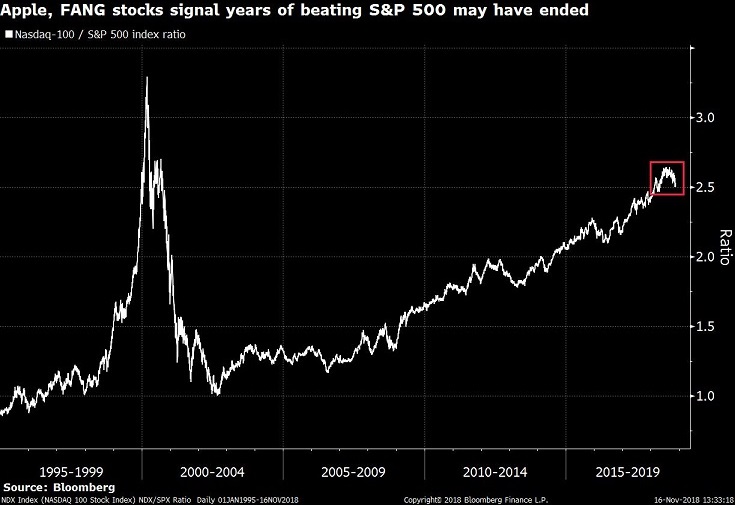
Years of Nasdaq beating S&P 500 may be at an end
Nasdaq stocks are in danger of losing their long-held status as U.S. market leaders, according to Michael Shaoul, chief executive officer at Marketfield Asset Management LLC. He raised the possibility in a report Thursday that tracked the ratio between the Nasdaq 100 and S&P 500 indexes. The ratio has fallen as much as 5 percent since July 25, when it peaked after rising 163 percent from a low in September 2002. Losses may mount, Shaoul wrote, because of concern about “future growth or profitability” for Apple Inc. and the four FANG stocks: Facebook Inc., Amazon.com Inc., Netflix Inc. and Alphabet Inc., Google’s owner.
Monday, September 3, 2018
Amazon reaches milestone before crossing $1 trillion
Amazon.com Inc.’s ascent toward $1 trillion in market value resulted in a stock-market milestone last month. The Internet retailer’s shares became the most expensive in the S&P 500 Index by surpassing those of Booking Holdings Inc., an online-travel company that held the top spot for the past 4 1/2 years. The position changed hands after Booking, formerly Priceline Group Inc., gave a disappointing earnings forecast in Aug. 9. The stock-price gap between them closed at $61.16 last week, when Amazon topped $2,000 for the first time.
Subscribe to:
Posts (Atom)