Showing posts with label shipping rates. Show all posts

Wednesday, June 29, 2022

Shipping rates retreat from their peak

Supply chain issues have created more demand for exports and driven shipping rates, ultimately reflected in how much a shopper pays for a given good. But those rates are starting to retreat from their peak.

Shipping rate for a 40 foot container from Shanghai to Los Angeles -- a route that Chinese exports are often taken through when sent to US consumers. 

In one way, this is the silver lining of inventory build ups seen across retailers -- there's less demand for more product, which in some ways insulates from shipping congestion and supply chain issues. But it's also helpful to break down inflation as pre-war contributors (shipping rates, demand resurgence) and post-war drivers (oil prices, grains export bans). To see this move in shipping rates could instill some optimism that those pressures are indeed easing. 

Monday, March 14, 2022

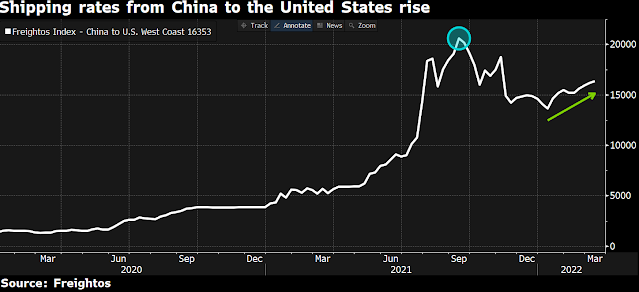
Global shipping rates rise

The war in Ukraine, the technology hub of China closed down, and record demand -- there's no shortage of inflationary pressures, something that has driven global shipping rates to multi-year highs. After September's peak, it seemed like perhaps the worst was behind us. 

However, warnings of a Russian invasion into Ukraine and ultimately, the war itself has created a surge in commodity demand on concerns of getting supply as quickly as possible before bans and sanctions are placed. That practice has pushed those rates higher. The full effect of those geopolitical tensions, however, tends to show up into shipping rates at a lag of at least six weeks. We're only on day 19.
 

Now, add on the closed Chinese tech hub of Shenzhen due to a rise in Covid cases. That's going to add even more supply chain pressures, which in theory would be another tailwind for shipping rates. For some macro-watchers, however, the concern is that rates aren't rising fast enough in the face of these hurdles, perhaps an early signal of slowing demand.

Wednesday, March 20, 2019

Falling U.S. freight shipments weigh on economy, truckers

The U.S. shipping industry shows “the reality of a slowing global growth story,” Peter Boockvar, Bleakley Financial Group LLC’s chief investment officer, wrote in an email Tuesday. Boockvar cited the year-to-year change in an index compiled by Cass Information Systems Inc., a freight-payment processor. The Cass Freight Shipments Index fell in February by 2.1 percent, the steepest drop since July 2016. Declining demand hurts trucking companies, and an S&P index tracking the industry fell Tuesday by 3.6 percent, its biggest loss of the year.

Tuesday, February 7, 2012

Dry-Bulk Rates Follow Stock Price Rebound

Shares of commodity-tanker owners may have foreshadowed this week’s rebound in shipping costs from a quarter-century low.
     Bloomberg index of dry-bulk shipping stocks started rebounding from a record low seven weeks before the Baltic Dry Index did the same. The chart tracks the two indicators since 2008, when calculations of the stock gauge begin.
     
Bloomberg’s global index of 14 shippers reached a record low on Dec. 19, when the Baltic Dry Index recorded the sixth of 33 straight losses. The gauge of shipping rates sank 66 percent during the streak to 647, the lowest reading since August 1986.
 
     Lower transportation costs reflect an excess of tankers available to carry iron ore and other commodities rather than a decline in the amount of cargo, Polys Hajioannou, chairman and chief executive officer of Safe Bulkers Inc., said yesterday during a Bloomberg Radio interview.
 
     “Demand is improving, but supply does not allow the freight market to do what it usually does,” Hajioannou said. He estimated that commodity shipments are climbing by 7 percent to 8 percent annually, and added that he expects tanker rates to move higher from next year onward.
 
     Shares of Safe Bulkers, based in Athens, rose 18 percent through yesterday from their price when the Bloomberg index set its low. The stock gauge advanced even more, 24 percent, during the period.