Showing posts with label SPACs. Show all posts

Monday, February 28, 2022

Special-purpose acquisition company (SPAC)

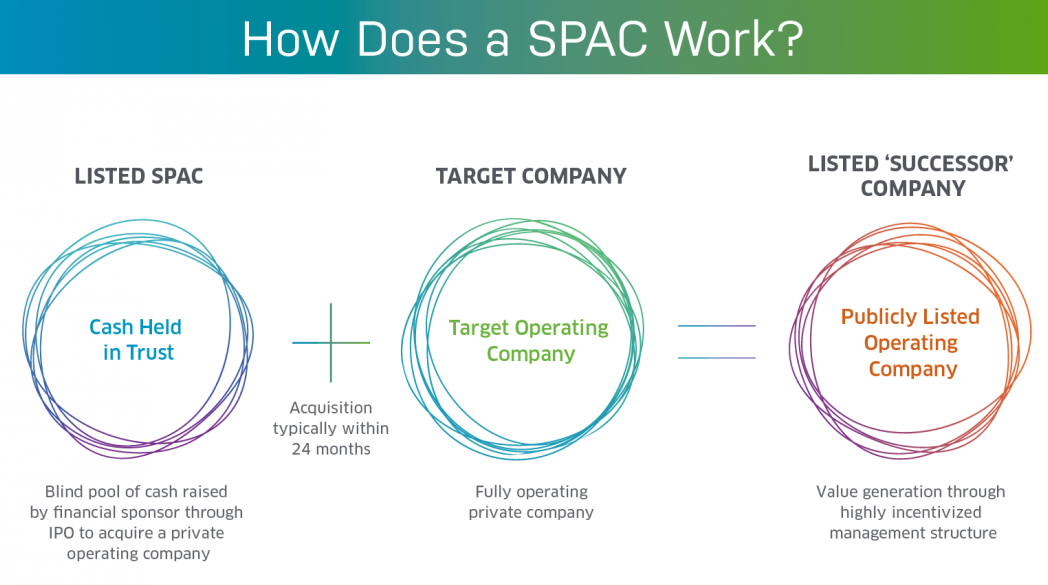
SPACs—or Special Purpose Acquisition Companies—are publicly-traded investment vehicles that raise funds via an initial public offering (IPO) in order to complete a targeted acquisition.

SPACs have become an increasingly popular way method of going public. Rather than go through the traditional IPO market, an investor or firm uses a SPAC to raise funds to finance an acquisition within a certain time frame – and the company that is acquired is effectively taken public.

It’s been a mania in SPACs as businesses shy away from the traditional initial public offering market roiled by the coronavirus pandemic and wild volatility. In 2020, there were more than 50 SPAC offerings, raising a record $21.5 billion, up 145% from the previous year, according to Goldman.

Bill Ackman’s Pershing Square Tontine Holdings raised $4 billion to become the largest SPAC in history. Other notable SPAC acquisitions this year include Nikola and DraftKings.

A SPAC is a blank-check company formed to raise funds to finance a merger or acquisition within a certain time frame, typically two years. The target firm will be taken public through the acquisition. Goldman estimated that completed SPAC offerings currently searching for acquisitions exceeds $38 billion.

SPAC deals have become a more popular way for companies to go public in recent years. The disclosures required are simpler than those in a traditional initial public offering. Unlike in a traditional IPO, companies participating in a SPAC merger are allowed to present forward-looking projections to investors, which can help justify a lofty valuation. But there’s no guarantee that those forecasts will come true.

Goldman analyzed 56 SPACs that completed translations since the beginning of 2018 and found that in the long run, they tend to underperform the broader market and returns are all over the place.

US SPACs, IPO capital raised:
  • 2013: $1 billion
  • 2014: $2 billion
  • 2015: $4 billion
  • 2016: $3 billion
  • 2017: $11 billion
  • 2018: $9 billion
  • 2019: $13 billion
  • 2020: $83 billion
  • 2021 YTD: $23 billion as of 1/26 (less than a month)
News:
  • Feb 19, 2021: Michael Dell, activist investor Paul Singer, Facebook Inc. co-founder Eduardo Saverin and former Xerox Corp. chief Ursula Burns all joined the blank-check parade on Friday, with at least 13 of these companies filing for U.S. IPOs to raise more than $4.5 billion.

Friday, October 22, 2021

Trump's blank-check deal follows months of SPAC malaise

Former President Donald Trump’s move to take a social-media business public through a blank-check company, Digital World Acquisition Corp., followed months of malaise for his partner’s peers. The Indxx SPAC & NextGen IPO Index fell 34% through Thursday from a record in February, according to data compiled by Bloomberg. The gauge consists of special-purpose acquisition companies and businesses that went public through mergers with SPACs. During the same period, the Renaissance IPO Index slid 7.7% and the Russell 3000 Index gained 13.5%.

Wednesday, June 16, 2021

Lordstown, DraftKings fit pattern among `De-SPAC' stocks

Lordstown Motors Corp. and DraftKings Inc. have a couple of things in common. Both businesses were taken public by special purpose acquisition companies, or SPACs, and both suffered stock-market setbacks this week. The latter reflects a trend that’s evident from the De-SPAC Index, consisting of companies whose deals were completed during the past 12 months. The index fell 27% through Tuesday from a high in February, according to data compiled by Bloomberg. Blank-check companies that have yet to make or complete deals held up better, as the IPOX SPAC Index dropped 23% from its February peak.

Friday, April 9, 2021

Nasdaq 100's rebound fails to carry over to IPOs, SPACs

Nasdaq’s biggest companies are close to completing an eight-week reversal that newly public U.S. companies can only wish for. The Nasdaq 100 Index’s close Thursday was just 0.4% away from a record set on Feb. 12. Initial public offerings have been left behind, as the Renaissance IPO Index trailed its Feb. 12 record by 15%. So have special purpose acquisition companies, as the Indxx SPAC & NextGen IPO Index was down 23% from a high on Feb. 16. SPACs were “the one area of excess to show no sign of recovery at quarter end,” Michael Shaoul, Marketfield Asset Management LLC’s chief executive officer, wrote Thursday in a report comparing the three indexes.


Thursday, December 10, 2020

Doordash, C3.ai are seen following U.S. IPO, SPAC excess

Surges in Doordash Inc. and C3.ai Inc. on the first day of trading were in keeping with rising speculation for U.S. stock investors, according to Jonthan Krinsky, chief market technician at Bay Crest Partners LLC. Krinsky cited the Renaissance IPO and IPOX SPAC indexes in a report Wednesday. Renaissance Capital LLC’s gauge of initial public offerings rose 32% from a late-October low through Tuesday. In a similar period, IPOX Schuster LLC’s index of current and former blank-check companies climbed 40%. The IPO index fell 3.2% Wednesday even as Doordash gained 86% and C3.ai jumped 120%. The SPAC index rose 0.3%.
 

Wednesday, October 21, 2020

SPACs, target companies are left behind as U.S. IPOs rise

U.S. companies along an alternative route to going public are being left by the wayside. The IPOX SPAC Index, tracking special-purpose acquisition companies and the businesses they make deals with, shows as much. The index retreated 8.4% through Tuesday from a peak on Sept. 18, according to data compiled by Bloomberg. Companies that chose initial public offerings over the blank-check route rose 12% in the same period, according to the Renaissance IPO Index. The SPAC slump followed “a bit of froth,” Jonathan Krinksy, chief market technician at Bay Crest Partners LLC, wrote Tuesday in a report.


Thursday, September 3, 2020

Electric cars : Solid-state lithium battery maker QuantumScape

Solid-state lithium battery maker QuantumScape is becoming a publicly traded entity through a merger with special purpose acquisition company, or SPAC, Kensington Capital Acquisition (NYSE:KCAC). QuantumScape wants to disrupt the automotive industry—and the EV space—by offering a better mousetrap.
Including $200 million from the Kensington’s trust fund and a $500 million private investment in public equity, or PIPE, the transaction will provide about $700 million in proceeds to QuantumScape. The deal values the company at about $3.3 billion.


None of the current shareholders are using the transaction as a chance to cash out—a good sign for any SPAC transaction. After the deal closes, QuantumScape will have north of $1 billion of cash on its balance sheet.

For QuantumScape, the “SPAC deal represented was a much faster and more streamlined way to become public compared with the traditional IPO process,” explains founder and CEO Jagdeep Singh. “Combined with the value that partnering with Kensington in particular brings—they’re a bunch of auto guys—it just made the most sense to take this route.”

Kensington Capital, the SPAC sponsor, is an automotive industry focused investment bank based outside of New York City. Justin Mirro, the SPAC’s chairman and CEO, began his career at General Motors (GM) before moving to investment banking focused on the automotive sector.
EVs appear to be taking over the car business—as the epic rise in Tesla (TSLA) stock portends. Telsa is now the world’s most valuable car company by a wide margin.

That makes EV batteries very important to the auto industry and to investors. Solid-state batteries promise lower cost and higher power density than existing battery technology. That’s a panacea for EV makers—a battery that is relatively cheap and light weight, making the upfront costs of EVs comparable to gasoline-powered cars. Solid state batteries charge faster too.

It’s taken a while to get solid state right. QuantumScape believes it is there, pointing out that Volkswagen (VOW.Germany) has tested and validated Quantum’s solid-state batteries and plans to commercialize them by 2025. That might feel like a long way off, but “the automotive cycle is long,” explains Singh. “People have recognized solid state potential for decades.”


Quantumscape CEO Jagdeep Singh (CNBC, 4 Jan 2021)