Showing posts with label Dividend Aristocrats. Show all posts

Saturday, January 28, 2023

Highest Yielding Dividend Aristocrats

Three stocks, C.H. Robinson Worldwide (CHRW), Nordson (NDSN) and J.M. Smucker (SJM), will join the storied S&P 500 Dividend Aristocrats on Feb. 1.

Those paying highest yields, with newest index additions shown for comparison.

Company
TICKER  
SECTORYears of dividend increasesDividend yield
VFVFCConsumer Discretionary506.8%
Walgreens Boots AllianceWBAConsumer Staples475.3
3M CompanyMMMIndustrials605.3
International Business MachinesIBMInformation Technology274.7
Realty IncomeOReal Estate284.4
AmcorAMCRMaterials394.2
T. Rowe Price GroupTROWFinancials364.1
Essex Property TrustESSReal Estate284.1
Franklin ResourcesBENFinancials414.0
AbbVieABBVHealth Care504.0
J.M. Smucker *SJMConsumer Staples252.7
C.H. Robinson Worldwide*CHRWIndustrials252.3
Nordson*NDSNIndustrials421.1
Sources: S&P Global Market Intelligence, IBD, * — new index additions

Friday, July 2, 2021

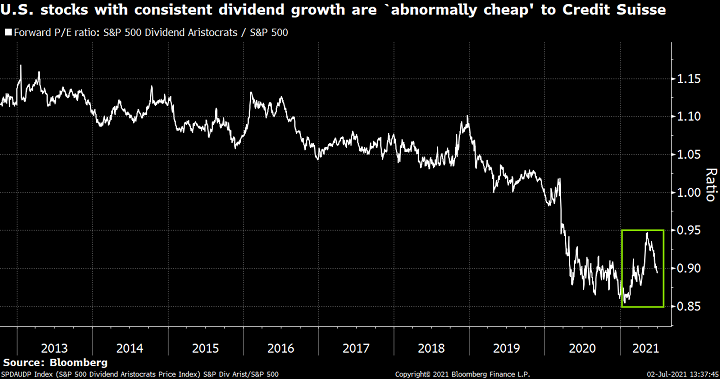
Dividend Aristocrats have become “abnormally cheap”

U.S. companies with a track record of raising dividends have become “abnormally cheap,” according to Andrew Garthwaite, a global strategist at Credit Suisse Group AG. Garthwaite endorsed the so-called dividend aristocrats in a report Thursday. Valuations of the S&P 500 Index’s aristocrats relative to the U.S. stock benchmark fell as much as 5.5% from a high on May 13 through Thursday, according to data compiled by Bloomberg. The decline is based on forward price-earnings ratios, which Garthwaite cited in the report.

Monday, December 7, 2020

U.S. dividend stocks look interesting again

 “It may be time to consider self-gifting dividends to your portfolio,” Lindsey Bell, chief investment strategist for Ally Invest Securities LLC, wrote Friday in a blog post. Bell cited the potential for dividend-paying U.S. stocks to regain strength as the economy rebounds from this year’s recession. She looked at the S&P 500 Dividend Aristocrats Index, consisting of companies that have increased dividends for at least 25 straight years. Through Friday, the index trailed the S&P 500 for the year by 8.4 percentage points. That would be the biggest annual shortfall since 1999, when the gap was 27 points.


Wednesday, April 8, 2020

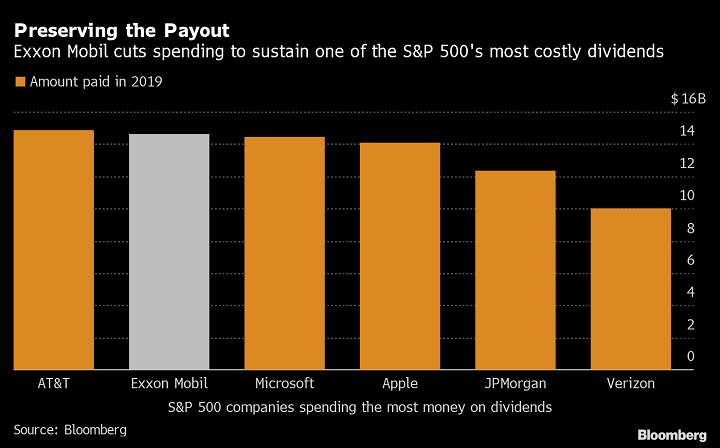
Exxon Mobil sustains costly dividend with spending cuts

Exxon Mobil Corp. wants to “preserve cash for the dividend” by reducing this year’s capital spending by $10 billion and making cuts in operating costs, Chief Executive Officer Darren Woods said in a statement Tuesday. Exxon needs more cash than almost every other company in the S&P 500 Index to sustain its payout. Last year, the largest U.S. energy producer paid $14.65 billion of dividends, according to data compiled by Bloomberg. Only AT&T Inc. spent more in 2019, as the phone and entertainment company distributed $14.89 billion.


Thursday, December 5, 2019

U.S. stocks with dividend history are focus for Credit Suisse

Buying shares of U.S. companies with a history of raising dividends may help investors limit the risk of higher interest rates next year, according to Andrew Garthwaite, a global strategist at Credit Suisse Group AG. He cited the S&P 500 Index’s “dividend aristocrats,” which have increased payouts for 25 years in a row or longer, in a report Wednesday. S&P’s index of the aristocrats is valued as if the 10-year Treasury note yielded 2.5%, Garthwaite wrote. The 10-year yield has been below 2.5% since May and stood at 1.77% yesterday.


Sunday, May 22, 2016

Dividend growth takes on more importance at Jefferies

Dividend growth has become just as important for U.S. stocks as earnings, according to Sean Darby, Jefferies Group LLC’s chief global equity strategist. Darby cited this year’s performance of the S&P 500 Dividend Aristocrats Index, consisting of companies that increased payouts for at least 25 straight years, in a report Monday. The index held a first-half lead of 5.1 percentage points over the S&P 500 through last week, and the gap would be the widest in its favor for a calendar half since 2008.

Friday, December 4, 2015

Dividend Aristocrats

The Standard & Poor's Dividend Aristocrats Index is made up of companies that have raised their payouts for at least 25 years in a row and are members of the S&P 500.  Some have paid dividends for more than 100 years!
  • https://www.spglobal.com/spdji/en/indices/strategy/sp-500-dividend-aristocrats/#index-linked-product
  • In 2015, there were 53 companies in the Aristocrats list, though a recent buyout reduced it to 52.
  • Launched in 2005, Standard & Poor's developed the S&P Dividend Aristocrats Index as a way to mimic an investment strategy that a handful of sophisticated dividend investors had been employing successfully for decades. (Note: Rather confusingly, this index is different from the "S&P High Yield Dividend Aristocrats Index," which is a less-exclusive group.)
  • The Dividend Aristocrat strategy is based on the premise that buying large-cap stocks with decades-long track records of increased payouts will deliver investors total returns that exceed those of just "buying the market" with a traditional market-cap-weighted S&P 500 Index fund.
  • In 2014, the S&P 500 Dividend Aristocrat Index posted a total return of 15.54%. By way of comparison, the S&P 500 Index has delivered investors a total return of 13.46% — a gap of more than 2%.
  • The exchange-traded fund SPDR S&P Dividend (SDY) tracks the S&P High Yield Dividend Aristocrats Index. The fund is a competitor to the popular iShares Select Dividend (DVY) which tracks the Dow Jones U.S. Select Dividend Index. The ProShares S&P 500® Dividend Aristocrats ETF (NOBL) is tracking the S&P 500 dividend aristocrats since 10/9/13.
  • During the 2008-09 bear market, 32 companies in the S&P 500 eliminated their dividend. Another 108 cut the payout.
December 2015


Which Dividend Aristocrat stocks posted the biggest price gains for 2015 through Nov. 20?

  • No. 1: Hormel Foods (NYSE:HRL) rose 30%. The dividend yield is 1.5%. Possible reason for price gains: After two years of single-digit earnings increases, EPS growth stepped up to 14% in 2014 and is expected to come in at 17% this year.
  • No. 2: Chubb (NYSE:CB) gained 25%. The dividend yield is 1.8%. Possible reason for price gains: a strong industry group. The Insurance Property Casualty Title group began the year as No. 62 of 197 industry groups. As of mid-November, the group was No. 14.
  • No. 3: Brown Forman (NYSE:BFB) advanced 20%. The yield is 1.2%. Possible reason for price gains: industry conditions. American whiskeys are seeing growing demand globally. Also, the Trade Promotion Authority law, signed by President Obama on June 29, opens more markets to whiskey.
  • No. 4: McDonald's (NYSE:MCD) is up 18%. The dividend yield is 3.2%. Possible reason for price gains: signs of a turnaround. EPS in Q3 jumped 28%, the best in at least 19 quarters. Same-store sales rose in the U.S. for the first time in two years.
  • No. 5: Clorox (NYSE:CLX) rose 17%. The yield is 2.5%. Possible reason for price gains: Earnings inched up just 1% to 3% in the past four fiscal years. But the Street sees a 9% rise in fiscal 2016 ending in June, which would be the best in seven years.


** Full list **

In 2015, Family Dollar Stores (FDO) was removed from the list due to its purchase by Dollar Tree.

The full list of 53 companies follows:
  1. 3M Company (MMM)
  2. AFLAC Inc. (AFL)
  3. AbbVie Inc. – (ABBV)
  4. Abbott Laboratories (ABT)
  5. Air Products & Chemicals Inc (APD)
  6. Archer-Daniels-Midland Co (ADM)
  7. AT&T (T)
  8. Automatic Data Processing (ADP)
  9. Bard, C.R. Inc (BCR)
  10. Becton, Dickinson & Co (BDX)
  11. Bemis Co Inc (BMS)
  12. Brown-Forman Corp B (BF/B)
  13. Cardinal Health Inc. – (CAH)
  14. Chubb Corp (CB)
  15. Chevron Corp. – (CVX)
  16. Cincinnati Financial Corp (CINF)
  17. Cintas Corp (CTAS)
  18. Clorox Co (CLX)
  19. Coca-Cola Co (KO)
  20. Colgate-Palmolive (CL)
  21. Consolidated Edison Inc (ED)
  22. Dover Corp (DOV)
  23. Ecolab Inc (ECL)
  24. Emerson Electric Co (EMR)
  25. Exxon Mobil Corp (XOM)
  26. Franklin Resources (BEN)
  27. Genuine Parts (GPC)
  28. Grainger, W.W. Inc (GWW)
  29. HCP (HCP)
  30. Hormel Foods Corp (HRL)
  31. Illinois Tool Works (ITW)
  32. Johnson & Johnson (JNJ)
  33. Kimberly-Clark (KMB)
  34. Leggett & Platt (LEG)
  35. Lowe’s Cos Inc (LOW)
  36. McCormick & Co (MKC)
  37. McDonald’s Corp (MCD)
  38. McGraw-Hill Cos Inc (MHFI)
  39. Medtronic (MDT)
  40. Nucor (NUE)
  41. PPG Industries Inc (PPG)
  42. PepsiCo Inc (PEP)
  43. Pentair Ltd. (PNR)
  44. Procter & Gamble (PG)
  45. Sherwin-Williams Co (SHW)
  46. Sigma-Aldrich Corp (SIAL) – acquired by Merck KGaA for $17.0 billion in September 2014.
  47. Stanley Black & Decker Inc. (SWK)
  48. Sysco (SYY)
  49. T. Rowe Price (TROW)
  50. Target Corporation (TGT)
  51. VF Corporation (VFC)
  52. Walmart (WMT)
  53. Walgreen Company (WBA)

Monday, December 15, 2014

Coca-Cola payout growth at risk?

 Coca-Cola Co.’s half-century streak of yearly dividend increases is in jeopardy because the beverage maker is “routinely outspending its cash flow,” according to David Winters, Wintergreen Advisers LLC co-founder and chief executive officer.

The chart compares Coke’s cash flow from operations with its total outlays for dividends, stock buybacks and capital spending in each year since 2000, according to data compiled by Bloomberg. Totals for the 12 months ended Sept. 30 are shown as 2014.


Coke spent $2.2 billion more than its cash flow in 2011 and gaps have persisted since then, Winters wrote in a report posted on his Mountain Lakes, New Jersey-based firm’s website yesterday that had a similar chart. The company has taken on debt to cover the outlays, the report said.

“Additional spending on executive bonuses and severance charges threatens to make this problem even worse,” he wrote. Winters estimated the company will pay at least $1 billion in cash bonuses next year under a compensation program, and will also take $1 billion or more in cash charges for job cuts and other restructuring moves.

Coke, based in Atlanta, has raised its dividend each year since 1963. The next payout is due to be declared in February and is poised to increase 8.2 percent, to 33 cents a share quarterly, according to a Bloomberg analysis.

“Putting Coke’s record of annual dividend growth at risk is irresponsible,” wrote Winters, whose firm has 2.5 million shares and has been a stockholder for more than five years. Wintergreen oversees $2 billion in assets.

Winters called for the replacement of CEO Muhtar Kent in a statement accompanying the report. He cited takeovers of Coca-Cola Enterprises Inc.’s North American unit and Glaceau, the maker of Vitaminwater, that cost a total of $16.3 billion and “destroyed shareholder value.”

Winters' assertions are without merit, Coca-Cola said in a statement.

“The Coca-Cola Co. is well-positioned to capture growth in the dynamic non-alcoholic ready-to-drink beverage industry,” according to the e-mailed statement. “Muhtar Kent and the company’s leadership team have outlined meaningful strategic plans to accelerate sustainable and profitable growth and deliver long-term value to our shareowners.”