Showing posts with label natural gas. Show all posts

Tuesday, July 5, 2022

Natural gas -- Dutch TTF

Natural gas trades at different prices in different parts of the world. There are three global benchmarks for natural gas, at hubs in the U.S., Europe and Asia. In Europe, the hub is in the Netherlands and the futures contract is known as Dutch TTF. In Asia, it’s the Japan Korea Marker, or JKM. In the U.S., gas trades at the Henry Hub in Louisiana.

Crude oil, by comparison, has been traded globally for decades, and prices around the world have converged more than natural-gas prices.  U.S. oil, in the form of the benchmark West Texas Intermediate (WTI) crude price, trades slightly below the global price, which is tracked by Brent crude futures, a product originally based on oil from Europe’s North Sea.
  
Dutch TTF natural gas, the European reference price, reached $166.72 on Tuesday, moving past the post-invasion high of over $154. Dutch TTF is calculated based on the price of liquefied natural gas, which is shipped by tanker around the world. Prices in the U.S., based on the cost of gas delivered by pipelines within the country, are significantly lower.


Supplies of gas to Europe from Russia are at seasonal lows because flows to the Dutch trader GasTerra and the renewable-energy company Orsted have been cut in response to their refusal to pay for gas in rubles, Citi strategists said. Russia’s Gazprom has stopped supplying gas to both companies because they refused to make their payments in the Russian currency at the end of May.

Tuesday, February 1, 2022

Natural gas stocks


ETFs:
UNG
FCG
KOLD

(by market cap)                        
Ticker   Company name Mkt Cap▼
  1. ENB Enbridge  76.70B ; assets in crude oil, liquids and natural gas pipelines, terminal and midstream operations; Calgary, Canada
  2. LNG  Cheniere Energy  43.91B; Texas; one of the world's largest liquefied natural gas (LNG) exporters.
  3. KMI  Kinder Morgan  39.66B; Texas; one of the largest natural gas infrastructure companies
  4. CTRA Coterra Energy  23.61B; Texas; explores for and produces oil, natural gas, and NGLs.
  5. EQT EQT Corp.  13.99B;  Pennsylvania
  6. CHK  Chesapeake Energy  11.73B; Oklahoma
  7. AR  Antero Resources 10.25B; Colorado
  8. DCP  DCP Midstream  8.21B; 35 natural gas processing plants; Colorado
  9. MGY  Magnolia Oil & Gas  7.20B; Texas
  10. RRC Range Resources  6.80B;  Texas
  11. SWN Southwestern Energy  6.93B; Texas
  12. DEN Denbury  4.85B; Texas; previously known as Denbury Resources (NYSE:DNR)
  13. ERF Enerplus 3.9B; Canada
  14. CRK Comstock Resources  3.85B; Texas
  15. VET  Vermilion Energy  3.70B; Canada
  16. CNX CNX Resources  3.35B; Pennsylvania; properties within the Appalachian Basin
  17. CRC California Resources Corporation 3.32B; California
  18. GLNG  Golar LNG   2.76B; Bermuda; nine LNG carriers, one FSRU, and three FLNGs
  19. NOG Northern Oil and Gas  2.72B; Minnesota
  20. CPE Callon Petroleum  2.71B; Texas
  21. ESTE Earthstone Energy  2.12B; Texas
  22. TALO Talos Energy  1.74B; Texas
  23. GPOR Gulfport Energy  1.69B; Oklahoma
  24. LPI Laredo Petroleum  1.08B; Oklahoma
  25. EGY VAALCO Energy  601.32M; Texas
  26. TK  Teekay   392.21M; Bermuda; fleet of 55 vessels
  27. GNE  Genie Energy  232.21M; New Jersey

++TELL

 Liquefied natural gas (LNG)
To move this cleaner-burning fuel across oceans, natural gas must be converted into liquefied natural gas (LNG), a process called liquefaction. LNG is natural gas that has been cooled to –260° F (–162° C), changing it from a gas into a liquid that is 1/600th of its original volume.

©Artremis / EAS (10/21/22)

Thursday, October 21, 2021

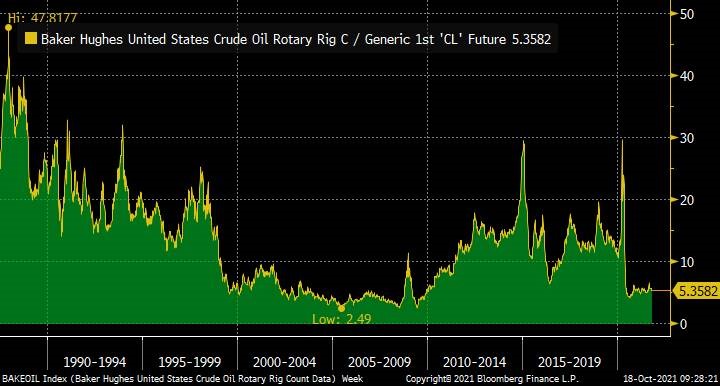
Drilling-rig gauge is seen working for U.S. energy stocks

Energy stocks stand to benefit from the U.S. industry’s “underinvestment” as oil and natural gas become more expensive, according to Richard Bernstein Advisors. The money manager made the case Monday in a Twitter post, citing the ratio between the number of drilling rigs in operation and the crude-oil price.

 
There were 445 rigs at work in the U.S. last Friday, according to data that Baker Hughes Co. compiles weekly. That’s equivalent to 5.4 times last week’s settlement price for West Texas Intermediate crude in New York trading. The ratio has averaged 12.1 times since 2010. 


The oil rig/oil price ratio reflects underinvestment similar to the 2000s when energy was the decade’s best performer.

Wednesday, March 11, 2020

Natural gas has bottomed out

One of this week's few winners is natural gas, which has finally bottomed out after making multi-year lows. ✅ 
Natural gas is a byproduct of shale oil. With the sharp drop in crude oil prices, the supply of natural gas will be reduced as many of the high-leveraged shale oil players go offline.
BTW, natural gas has replaced coal to a large extent in electricity production.


Wednesday, April 11, 2012

Record oil-gas ratio may spur truck-fuel shift

Natural gas is the truck fuel of the future because crude oil and related products have become
increasingly costly in relative terms, according to Alexander E. Potter, an analyst at Piper Jaffray Cos.
     

The above chart tracks the price ratio between a barrel of oil and a million British thermal units of gas on the New York Mercantile Exchange. The ratio rose above 50 yesterday for the first time since gas futures began trading on the Nymex in April 1990.

     Average U.S. pump prices for the diesel fuel used in trucks have risen about three times as much as crude since 2008, when the chart begins, according to data compiled by the American Automobile Association.
     “Natural gas is replacing diesel as the preferred truck fuel,” Potter, based in Minneapolis, wrote in a report two days ago. He estimated that trucks running on compressed or liquefied natural gas may rise to 20 percent of sales in five years. They accounted for only 0.9 percent of North American sales in 2010, according to Frost & Sullivan, a consulting firm.

     Trucking companies can save as much as $32,000 a year by fueling their vehicles with gas rather than diesel, the report said. The savings approach the $35,000 cost of converting to a gas-powered truck.

     “Diesel will one day be considered obsolete when it comes to fueling truck fleets,” Potter wrote. He recommended buying shares of Westport Innovations Inc., the maker of a gas engine suitable for heavy trucks, to profit from the shift.