Showing posts with label auto stocks. Show all posts

Wednesday, September 2, 2020

Tesla nears almost all its peers combined in market value

Could Tesla Inc. be more valuable than 18 other automakers in the U.S., western Europe and Japan combined? From a stock-market perspective, the answer is yes -- almost. The electric-car maker came within $1.3 billion on Monday of exceeding the MSCI World Automobiles Index’s market value after excluding Toyota Motor Corp., according to data compiled by Bloomberg. The gap started the year at $478.3 billion and dwindled as Tesla surged sixfold through Monday. Every other automaker in MSCI’s index fell in the period except Ferrari NV, which rose 10%.


Monday, April 27, 2020

U.S. stocks are seen signaling economic bottom is near

U.S. stocks are signaling that the economy’s coronavirus-driven decline may reach a low point sooner rather than later, according to Jim Paulsen, Leuthold Group Inc.’s chief investment strategist. 

The performance of restaurant, auto and homebuilding shares in the S&P 500 Index was among the indicators he cited in a report Friday. All three groups rose more than 19% in the past three weeks and surpassed the S&P 500’s gain of 14%, according to data compiled by Bloomberg. “Markets may be giving the best information available regarding the timing of a potential bottom in the economy,” Paulsen wrote.


Thursday, January 9, 2020

Tesla has higher value than Ford, GM together after surge

Tesla Inc. became more valuable to U.S. stock investors Tuesday than Ford Motor Co. and General Motors Co. combined. The electric-car maker’s market value closed at $88.7 billion, surpassing an $86.2 billion total for Ford and GM, according to data compiled by Bloomberg. Tesla’s value rose more than 175% through Wednesday from a low in June as the company reported a surprise third-quarter profit and began production from a new Chinese factory. Along the way, Tesla exceeded Ford’s record market value of $80.7 billion in May 1999, along with GM’s post-bankruptcy peak of $66.9 billion in October 2017.


Tesla Inc.’s record-setting stock surge has left Wall Street analysts in the dust. Their average 12-month price projection for the electric-car maker, based on a Bloomberg survey, trailed Tuesday’s close by 34%. Only three of 30 firms to set targets, Argus Research, Jefferies Financial Group Inc. and Oppenheimer & Co., had estimates above the current price -- and all of them were raised within the past week. Tesla also had a lower consensus analyst rating, compiled from buy, hold and sell recommendations, than about 90% of the stocks in the Russell 3000 Index. The consensus included 15 sells, the most of any Russell 3000 company.

TM, TSLA, VW, GM, F  (Jan 22, 20)


Sunday, December 29, 2019

Auto stocks

(by market cap)                        
Company name Mkt Cap▼
  1. TSLA  Tesla Inc  USA  1074.54B
  2. TM  Toyota Motor Japan  253.11B
  3. RACE  Ferrari N.V  Italy  87.47B
  4. GM   General Motors USA  48.51B
  5. HMC  Honda Motor Japan  45.82B
  6. F  Ford Motor  USA  42.15B
  7. STLA  Stellantis N.V  Netherlands  31.40B
  8. LI  Li Auto Inc China  23.36B
  9. RIVN  Rivian Automotive USA  17.05B
  10. XPEV  XPeng China  16.12B
  11. VFS  VinFast Auto USA  8.70B
  12. LCID  Lucid Group USA  8.08B
  13. NIO  NIO Inc China  8.01B
  14. ZK  ZEEKR Intelligent Technology China  7.24B
  15. PSNY  Polestar Automotive Sweden  2.14B
  16. LOT  Lotus Technology  China  1.45B
  17. CYD  China Yuchai International Singapore 674.95M
  18. NIU  Niu Technologies China  247.26M
  19. LVWR  LiveWire Group USA  223.92M
  20. NWTN  NWTN Inc  United Arab Emirates  198.69M
  21. FFAI  Faraday Future Intelligent Electric USA  113.28M
  22. GGR  Gogoro  Taiwan  85.47M
  23. CJET  Chijet Motor  Cayman Islands  66.65M
  24. CENN  Cenntro  USA  31.48M
  25. FLYE  Fly-E Group  USA  12.64M
  26. ECDA  ECD Automotive Design USA  12.56M
  27. LOBO  Lobo Ev Technologies Ltd  China  10.61M
  28. EVTV  Envirotech Vehicles USA  6.01M
  29. WKHS  Workhorse Group  USA   5.28M
  30. AYRO  AYRO Inc  USA  3.75M
  31. VLCN  Volcon Inc USA  3.23M
  32. ZAPP  Zapp Electric Vehicles United Kingdom  2.58M
  33. AIEV  Thunder Power Holdings USA  0.51M
  34. MULN  Mullen Automotive USA  0.40M

  35. --------------

  36. SPAR  Spartan Motors 612M
  37. KNDI Kandi Technologies China 240M
  38. SORL SORL Auto Parts China 89M
  39. PCAR commercial trucks
©Artremis / EAS (5/13/25)

finviz charts (ave vol - 30 days, new window): 
http://finviz.com/screener.ashx?v=211&t=TM,HMC,F,GM,NSANY,TSLA,TTM,KNDI,SORL&ta=0&o=-averagevolume


Others:
  • BMW (OTC: BAMXY)
  • Mercedes-Benz (OTCPK:DDAIF)
  • Nissan (OTCPK:NSANY)
  • PSA Peugeot Citroen (OTCPK:PEUGF)
  • Renault (OTC:RNSDF)
  • Volkswagen AG (OTC: VLKAY)
  • Hyundai (OTCPK:HYMLF)
  • Subaru (OTCPK:FUJHY)
  • Porsche (OTCPK:POAHY)
  • Mazda (OTCPK:MZDAY)
  • Nu Ride (OTCPK:NRDE); formerly Lordstown Motors (RIDE)
Delistings:
  • Tata Motors (NYSE:TTM) voluntarily delisted its American Depositary Shares (ADSs) from the NYSE on January 23, 2023.

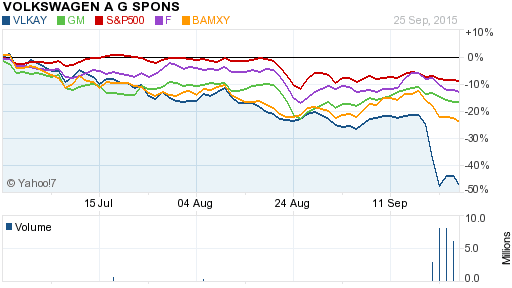
9/15:  Volkswagen emission-cheating scandal - VW, BMW, GM, F and S&P  

Also related to auto industry:
  • JCI      Johnson Controls    34.77B
  • ORLY   O'Reilly Automotive   23.24B
  • AZO   AutoZone    22.28B
  • MGA  Magna International; Canada; auto parts  16.95B
  • AA      Alcoa           16.12B
  • GPC   Genuine Parts Company   14.22B
  • AAP   Advance Auto Parts   11.15B
  • KMX   CarMax   10.61B
  • AN    AutoNation      6.49B     automotive retailer
  • ADNT   Adient     6.0B   The world's largest global automotive seating supplier. (spinoff from Johnson Controls)
  • PAG  Penske Automotive 3.87B
  • GPI   Group 1 Automotive  1.77B 
  • AXL    American Axle & Manufacturing 1.41B   automotive supplier
  • MTOR   Meritor  1.28B
  • UXIN Uxin  788.19M; operates a used car e-commerce platform in China
  • CARZ  First Trust NASDAQ Global Auto ETF   33.50M
  • +Carvana CVNA; +TRUE
  • +MPAA
  • ++ALSN auto parts
  • ++HLLY auto parts
  • +LMPX
  • +CARG
  • +CRMT used-car dealership
  • +SFT Shift Technologies used-car dealership; founded in 2013; filed for Chapter 11 bankruptcy in 2023 and is no longer in operation
  • +LOTZ  CarLotz  used-car dealership; merged  with Shift Technologies, Inc. (Nasdaq: SFT) in August 2022; Shift Technologies for Chapter 11 bankruptcy in 2023
  • +VRM  Vroom used-car dealership
  • +ABG dealership
  • +CARS cars.com
  • +DRVN
  • +CPRT
  • AUTO AutoWeb is an automotive media and marketing services company based in Irvine, California.


6/15:  major automakers - 3 months (click for a live chart)


Share of global car market, 2017:
  • Toyota: 9.2%
  • Volkswagen: 7.2%
  • Ford: 6.5%
  • Honda: 5.4%
  • Nissan: 5.4%
  • Hyundai: 4.7%
  • Chevrolet: 4.4%
  • Kia: 3%
  • Renault: 2.8%
  • Mercedes: 2.7%
  • Peugeot: 2.2%
  • BMW: 2.2%
  • Audi: 2%
  • Maruti: 1.7%
  • Mazda: 1.7%
  • Fiat: 1.7%
  • Suzuki: 1.6%
  • Buick: 1.5%
  • Jeep: 1.5%
(GAD)

Sunday, December 15, 2019

U.S. auto-dealer stocks leave Ford, GM to eat their dust

Selling cars and trucks has produced much more of a payoff for U.S. stock investors this year than making them. An index consisting of CarMax Inc. and five other auto dealers soared 85% for the year through Friday, according to data compiled by Bloomberg. The gain was far larger than the 14% advance for an index of Ford Motor Co. and General Motors Co., the manufacturers cited in a report Thursday by Edward Yardeni, president and founder of Yardeni Research. Dealers’ domestic focus largely explains the disparity, he wrote, adding that international sales at Ford and GM dropped in the third quarter.


Tuesday, October 23, 2018

Rates send U.S. housing, auto stocks into bear market

Shares of U.S. homebuilders and automakers are “over their skis” as a result of higher interest rates, according to Josh Brown, Ritholtz Wealth Management LLC’s chief executive officer. Brown cited the industries in a post Monday on his blog, the Reformed Broker. Bear markets in both groups began after the S&P Composite 1500 Index, combining the S&P 500, MidCap 400 and SmallCap 600 indexes, peaked Jan. 26. The composite’s housing index fell 37 percent from that date through Monday and its auto gauge lost 29 percent.


Wednesday, September 26, 2018

Electric cars

Only 6% of U.S. drivers own an alternate fuel vehicle, but surveys found that 53% are potentially interested in purchasing one. Millennials — generally the population born between the early 1980s and early 2000s — have a relatively high level of interest in electric vehicles (EVs).

An all-electric car is powered only by an electric motor that receives electricity by plugging into the grid. These cars consume no gasoline and produce no tailpipe emissions. However, the level of overall emissions depends on the amount of coal used to make electricity.


While high-end Tesla Motors (TSLA) is selling all the plug-in Model S sedans it can make, expected to be more than 35,000 this year worldwide, General Motors (GM) and Nissan (NSANY) have had to discount sale prices and leases to move the Chevy Volt plug-in hybrid and Nissan Leaf plug-in EV. In the U.S., GM sold only 3,606 Volts in Q1 2014, while Nissan sold just 5,184, though that was a 46% jump for the Leaf from the year-earlier quarter.

Electric vehicle sales have largely failed to meet manufacturers' sales expectations because their capabilities and features fall short of customer expectations, but the outlook for the EV market is improving.

High prices and long recharge times are 2 good reasons why electric vehicle sales haven't taken off, aside from Tesla sales.

Consumers prefer a driving range on a single charge of more than 250 miles, but EVs available today typically have a range of 100 to 200 miles. (Regulators give the Tesla Model S with an 85 kWh battery a range of 265 miles.) And the average battery recharge time considered acceptable by consumers is 2.74 hours, but today it typically takes three to 20 hours to recharge an EV, the study notes.

Price is still an issue with most of consumers expecting to pay less than $20,000.


After a federal tax credit, the Tesla Model S costs at least $63,570 to buy. Nissan advertises its Leaf as starting at $21,480 after the credit and GM advertises the Volt for as low as $26,685 after the tax credit. It also now sells the tiny Chevy Spark EV for $19,185 after the tax credit.

Among other plug-ins on the market, Ford (F) sells the C-Max Energi Plug-In Hybrid for $32,920 and the Fusion Energi SE for $34,700, while Toyota (TM) offers the Prius Plugin for $29,990.

Survey found gas-electric hybrids to be the most popular choice among people interested in possibly buying alternate-fuel vehicles for their next auto purchase. Natural gas vehicles were of interest to 22% of drivers, followed by plug-in hybrids at 19% and diesels at 18%.

BMW's new Mini electric concept car drives, parks, and charges itself

2016 Mercedes-Benz C350e

Sunday, August 4, 2013

Electric cars : Tesla Motors

Move over Porsche, Audi and Jaguar. In the world’s most cutting-edge car market, Tesla Motors has the fastest-growing luxury sedan. And it has no exhaust pipe.

Global sales of pure electric, hybrid and fuel cell cars topped 110,000 in 2012, according to the International Energy Agency, more than double 2011’s sales but less than 0.2 per cent of overall sales. The US has about 75,000 EVs on its roads, far below the 1m target by 2015 set by President Barack Obama in 2011.

Battery efficiency is improving at about 5 to 8 per cent a year, he says, bringing the technology to the mass market in three to five years. Some mass-market manufacturers have defied the electric naysayers. Nissan’s chief executive Carlos Ghosn in 2007 pledged that the Japanese company would produce the first mass-market electric vehicle. Four years later its Leaf became the world’s biggest-selling electric car.


But with sales of about 26,000 last year, it is still far from a household name: Porsche sold the same number of Carerra 911 sports cars in the same period.

Renault, Europe’s biggest electric car company by sales with 51 per cent of the continent’s zero-emission market, expects its EV sales to double this year to 36,000. “Timing is running on our side. This story will only go in this direction,” says Mr Tavares, his hand shooting upwards. “You are educating your kids, and I am educating my kids and my grandkids in a way that they understand they only have one planet.”
. . .
Established carmakers are hampered by their big investment in the internal combustion engine, making it hard to make the leap to a new technology that, in its early stages, appears less promising.
The Zoe, Renault’s compact EV, starts at €21,000 in France. But next to it in the showroom is a petrol-powered Clio, which costs €8,000 less. Insides big car companies, comparisons like this have made it hard to justify ramping up their investment programmes in electric.

Tesla faces no such qualms. “It’s a reality of business that disruptive changes always come from new entrants ... It’s kind of the iPhone moment,” says Mr Jurvetson. “If you’re in the auto industry it’s the most disruptive change you’ve seen in a long time.”

If the Model S turns out to be the forerunner of an electric-powered vehicle with mass appeal, however, the established carmakers will soon be forced to react far more aggressively than they have up to now.

“I believe the Model S will be considered more important than the Model T,” says Mr Jurvetson, displaying the bravado that typifies Tesla. “[It is] a catalyst that will eventually transform all transportation. The true mass market will happen much faster than anyone thinks.”


Tesla
  • The Model S costs about $70,000 and the sporty roadster retails at $100,000, before government incentives.
  • In Q2 2013, Tesla sold 5,150 Model S vehicles in North America, up from 4,900 in Q1.
  • Enterprise Rent-A-Car started offering the Model S in June 2013 as part of its Exotic Car Collection. Its Dream Car offerings already included the Tesla Roadster and other luxury cars such as the Aston Martin V8 Vantage, Lamborghini Gallardo and Porsche Boxster.
** click for chart  (new window)**

Tesla CEO Elon Musk 

March 2015 news:
  • Mercedes is launching its first plug-in hybrid-electric midsize sedan, the C350e, in U.S. dealerships in September 2015, according to reports. Chatter on the street suggests that the German auto-making powerhouse plans to deeply undercut Tesla stickers, with a price around $42,000 before $5,250 worth of federal and state incentives. The 85 kWh Tesla starts at twice that level. And the brash young automaker will not have a competitive product until at least 2017. Mercedes can undercut the pricing because it has a lot more experience at mass production and sourcing; will make the car in low-cost Alabama instead of high-cost California; and it can subsidize the vehicle with its other vehicles, just to gain market share. The market for electrics is growing dramatically; this is just the start.
2016 Mercedes-Benz C350e

Monday, July 29, 2013

Electric cars: BMW i3

BMW has unveiled its first mass-production electric car, the i3:


The German car maker says the i3 can accelerate from 0-60 mph in just over seven seconds and deliver up to 100 miles of driving between charges.


The car has caused a stir because it is battery powered, costs less than some run-of-the-mill BMWs at $41,350 and is said to perform more like a sports car than a golf cart. However, people may wind up talking just as much about an optional on-board gasoline powered generator that extends its range. BMW seems to have borrowed the feature from the Chevrolet Volt.

The i3 also stands out because its main body, called the passenger cell, is made of plastic.

This isn’t ordinary plastic, but carbon fiber reinforced plastic or CFRP, which BMW said is as strong as steel but weighs half as much. The material, which is used in racing cars and a few exotic sports models, also weighs 30% less than aluminum. The i3, which has the space of BMW 3 Series sedan but the smaller footprint of a 1 Series car, weighs about 2,700 pounds, or about the same as a Mini Cooper S.

The car’s structure is part of what BMW calls the “LifeDrive architecture concept” in which the vehicle is formed of a life module, or passenger compartment, and a drive module that contains the electric drive system, rear suspension and energy-absorbing framework for protection in a crash. The drive module is made of aluminum.

The standard i3 has a range of 80 to 100 miles on a charge and can be recharged in three hours with a 220-volt, 32-amp “level 2” charger. Fast charging, which charges the battery in 30 minutes, is available as an option.

To cut down on the range anxiety that keeps some drivers from considering electric cars, BMW is offering a 650cc, 34 horsepower, two-cylinder gas engine that is mounted in the rear of the car and serves as a generator to maintain the battery’s charge and keep the car going for about double its normal electric-only range. This range-extending system adds about 330 pounds to the vehicle, BMW said.

While the optional engine doesn’t drive the car’s wheels, it would change its character to that of a plug-in hybrid, not a pure electric car like a Tesla Model S or Nissan Leaf.

Tesla Model S vs BMW i3