Showing posts with label sanctions. Show all posts

Thursday, February 24, 2022

Russia's cash reserves

Since the Crimea Annexation in 2014 and the Western sanctions that followed, Russia has been building up its reserves. In 2014, the nation had about $400 billion stored away. Now, that figure is ~$630 billion -- made up less and less of the U.S. dollar (the world's reserve currency.) It's that role that makes sanctions traditionally effective as it has consequences for trade and payments around the world. But for Russia, only 16.4% of their reserves are made up of the greenback, down from ~22% just one year ago and 40% four years ago. Instead, the nation has opted for euros and yuan.
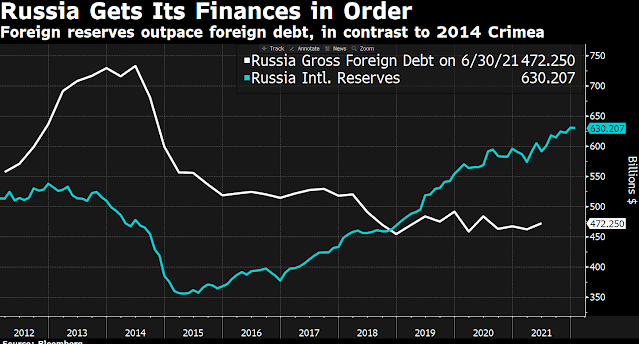
Russian currency reserves and its foreign debt.

At the same time, its foreign debt has been decreasing too from $732 billion in 2014 to $472 billion as of most recent data. 40% of its exports now use the dollar, down from 100% in 2013. The dollar's share of Russian imports has also dropped to 60% from 90%, respectively. Add on slashed Treasury holdings and it's clear there is a degree of insulation in Russia's economy when it comes to the fallout from Western sanctions.

Monday, January 28, 2019

The U.S. announces sanctions on Venezuela's state oil firm PDVSA

The Trump administration issued new sanctions on Venezuela’s PDVSA that effectively block the regime of President Nicolas Maduro from exporting crude to the U.S.

  • PDVSA is the state-owned oil & gas company.
  • Venezuela has the largest oil reserves in the world.
  • The U.S. recognizes National Assembly leader Juan Guaidó as interim president of Venezuela. Guaidó has promised to host free and fair elections.
  • The Trump administration announced it is blocking all U.S. revenue to Venezuela’s national oil company and called on members of the armed forces to switch their allegiance to Juan Guaidó.


Juan Guaidó, left, and Nicolás Maduro are locked in a confrontation over the right to govern Venezuela.


Oil has advanced 14 percent this year as the Organization of Petroleum Exporting Countries and allies curbed output to ease glut concerns. Nevertheless, price gains have been capped by record American output, expanding stockpiles and the U.S.-China trade war. Talks between the world’s two biggest economies later this week may provide the catalyst for crude to break out of its recent tight trading range.

West Texas Intermediate crude for March delivery rose 19 cents to $52.18 a barrel on the New York Mercantile Exchange at 9:11 a.m. in Singapore. The contract fell $1.70 to close at $51.99 a barrel on Monday.

Brent for March settlement declined 10 cents to $59.83. It broke below $60 for the first time in almost two weeks on Monday, dropping $1.71 to $59.93 on the London-based ICE Futures Europe exchange. The global benchmark crude was at a $7.94 premium to WTI.